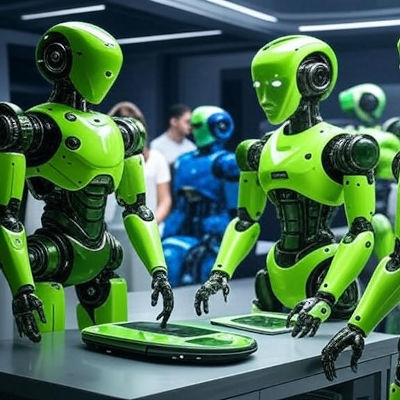

Robots need lots of data from sensors and quick artificial intelligence (AI) processing. This helps them run tasks in real time. The new Jetson Thor module from NVIDIA, now available, offers much more power than the older Jetson Orin. It has 7.5 times more AI compute and twice the memory for storing data.
This upgrade lets robots handle fast sensor data and do visual reasoning right on the device (edge AI processing), without sending info far away. Before, this was too slow for changing environments. Now, it opens doors for multimodal AI, which uses many types of data like sight and sound, in things like humanoid robots that look and move like people.
Companies are adopting it quickly. Agility Robotics uses Jetson in its Digit robot for warehouse jobs like stacking boxes, and plans to switch to Thor for better real-time decisions and more skills. Boston Dynamics integrates Thor into its Atlas humanoid for advanced compute usually found in big servers, plus fast data handling on the robot itself.
Beyond humanoid robots to broader uses
Jetson Thor speeds up other robots too, like surgical helpers in hospitals, smart farm tractors, delivery bots, factory arms, and visual AI agents that watch videos for safety.
Built for generative reasoning models, it runs big models like transformers and vision language models that understand images and words. These work in real time with low cloud use.
Research labs at places like Stanford and Carnegie Mellon use Thor to improve robot seeing, planning, and moving in tough spots, like search and rescue. Upgrading boosts their AI models and lets them test groups of robots.
In other NVIDIA news, NVIDIA researchers have introduced Jet-Nemotron, a new family of language models, which matches the accuracy of leading models while delivering up to 53.6x generation throughput speedup. Also, according to the company, small language models (SLMs) are sufficiently powerful, inherently more suitable, and necessarily more economical than large language models for many invocations in agentic systems, and are therefore the future of agentic AI.