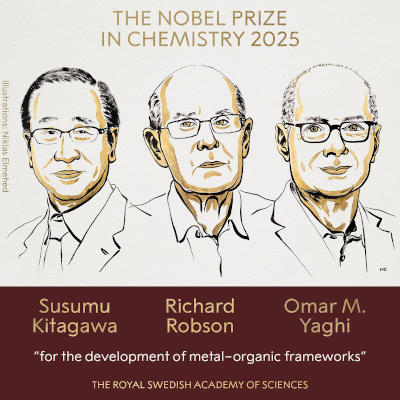

The Nobel Prize in Chemistry 2025 has been given to Susumu Kitagawa, Richard Robson, and Omar Yaghi. They are recognized for creating metal-organic frameworks, which are porous materials formed by linking metal ions with long organic molecules made mostly of carbon.
These frameworks permit to create crystals with huge empty spaces inside, like a diamond structure filled with rooms that let gases or chemicals pass through easily. By changing the metals and organic parts, chemists can tailor these materials to grab specific substances or even conduct electricity. The chair of the Nobel Committee notes that these frameworks open doors to custom materials with fresh uses, far beyond what was possible before.
Richard Robson started this work by mixing copper ions with a molecule that has four arms, each ending in a group drawn to the ions. This formed an ordered crystal with big cavities, though it was fragile and fell apart quickly. Susumu Kitagawa and Omar Yaghi built on this to make stronger versions. Kitagawa showed that gases could flow in and out without harming the structure and found ways to make the frameworks flexible, like lungs that expand and shrink with breathing.
Breakthroughs and applications
Omar Yaghi made a very stable framework called MOF-5, with zinc and organic links, offering massive inner surface area - as much as a football field in just a few grams - for soaking up gases better than older materials like zeolites, which are rigid silicon-based pores. He also proved these could be designed rationally, creating families of variants with different cavity sizes for targeted jobs. Since their discoveries, thousands of such frameworks have been made. They hold promise for pulling water from dry desert air using sunlight to release it as drinkable liquid, trapping carbon dioxide from factories to fight climate change, storing hydrogen safely for clean fuel in cars, removing forever chemicals like PFAS from water, or breaking down drug traces in the environment. These inventions could help tackle big human problems through smarter, tunable materials.