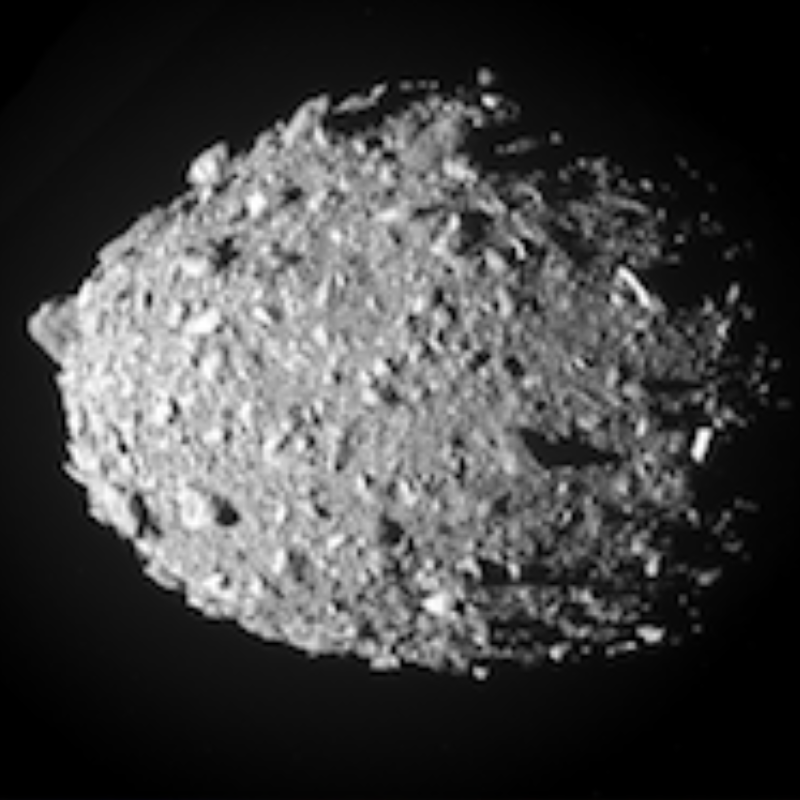

Situation: An asteroid is heading toward Earth. Scientists calculate that deflecting the asteroid to defend the planet against catastrophic impact with a conventional kinetic impact will not work. Why? Limitations in the mass that can be lifted to space.
Solution: Researchers at Lawrence Livermore National Laboratory (LLNL) say they have developed a modeling tool for assessing the potential use of a nuclear device. The research, published today (Dec. 19, 2023) in Planetary Science Journal, introduces a novel approach to simulating the energy deposition from a nuclear device on an asteroid's surface.
This new tool improves our understanding of the nuclear deflection's radiation interactions on the asteroid's surface. It also opens the door to new research on the shockwave dynamics affecting the inner asteroid.
This model will allow researchers to build upon the insights gained from NASA’s recent Double Asteroid Redirection Test (DART) mission in Sept. 2022, when they deliberately crashed a nuclear device into an asteroid to alter its trajectory.
Nuclear devices have the highest ratio of energy density per unit of mass of any human technology, making them an invaluable tool in mitigating asteroid threats, said LLNL physicist Mary Burkey, who led the research.
A long-range decision: to smash or deflect?
“If we have enough warning time, we could potentially launch a nuclear device, sending it millions of miles away to an asteroid that is headed toward Earth,” Burkey said. “We would then detonate the device and either deflect the asteroid, keeping it intact but providing a controlled push away from Earth, or we could disrupt the asteroid, breaking it up into small, fast-moving fragments that would also miss the planet.”
Accurate predictions for the effectiveness of nuclear deflection missions rely on sophisticated multiphysics simulations, Burkey said, explaining that LLNL simulation models cover a wide range of physical factors, which makes them complex and computationally demanding.
Asteroid x-rays
The paper also introduces an efficient and accurate library of X-ray energy deposition functions. High-fidelity simulations tracked photons penetrating surfaces of asteroid-like materials such as rock, iron, and ice, while accounting for more complex processes, such as reradiation.
The model also considers a diverse set of initial conditions, including different porosities, source spectra, radiation fluences, source durations, and angles of incidence. This comprehensive approach makes the model applicable to a wide range of potential asteroid scenarios.
High-fidelity simulation modeling
Should a real planetary defense emergency arise, high-fidelity simulation modeling will be critical in providing decision-makers with actionable, risk-informed information that could prevent asteroid impact, protect essential infrastructure and save lives, explained Megan Bruck Syal, LLNL’s planetary defense project lead.
“While the probability of a large asteroid impact during our lifetime is low, the potential consequences could be devastating,” Bruck Syal said.
Citation: Mary T. Burke, Robert A. Managan, Nicholas A. Gentile, Megan Bruck Syal, Kirsten M. Howley and Joseph V. Wasem. December 19, 2023. Planetary Science Journal, Vol. 4, Number 12. https://iopscience.iop.org/article/10.3847/PSJ/ad0838 (open access).