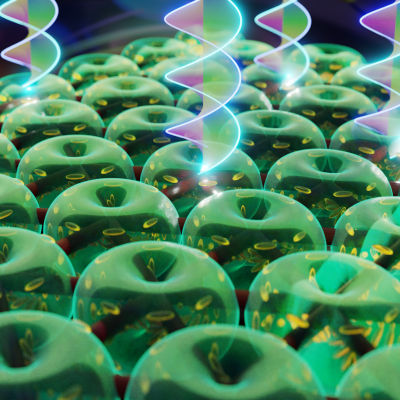

Scientists have created miniature optical tornadoes, where light behaves like a twisting whirlwind inside an extremely small structure. This breakthrough combines ideas from quantum mechanics, materials science, and optics. It could lead to simpler ways of making tiny light sources with complex properties for future technologies.
Optical tornadoes refer to light waves that twist around their axis in a spiral pattern, known as an optical vortex. These carry orbital angular momentum.
The researchers used liquid crystals. Inside the liquid crystals, they formed natural defects named torons. A toron is a tightly twisted, ring-shaped spiral structure, somewhat like a doughnut made from coiled DNA-like strands of molecules. These torons act as tiny traps that hold and shape light. This research is published in Science.
New natural way to create optical tornadoes in liquid crystals
To make light twist in a controlled way, the scientists used spatially variable birefringence, a property where different light polarizations travel at slightly different speeds. This effect bends light paths in a way that mimics magnetic forces on electrons.
The toron was placed inside an optical microcavity. An external electric voltage allowed control over the size and behavior of the light trap.
Surprisingly, the twisting light appeared in the ground state, the lowest and most stable energy level. This makes it much easier to produce laser light that is coherent, meaning the waves stay perfectly in step with a clear direction and energy. The system worked even when a laser dye was added, turning the trapped light into actual laser emission with rotational properties.
This approach avoids the need for complex manufactured nanostructures. Self-organizing materials like liquid crystals may allow more scalable production of advanced light devices for optical communication and quantum technologies. The work draws inspiration from atomic physics and even concepts related to fundamental particles, showing photons can mimic more complex behaviors than previously achieved in such compact setups. The researchers note that they have "managed to make photons behave not even like electrons, but like quarks."