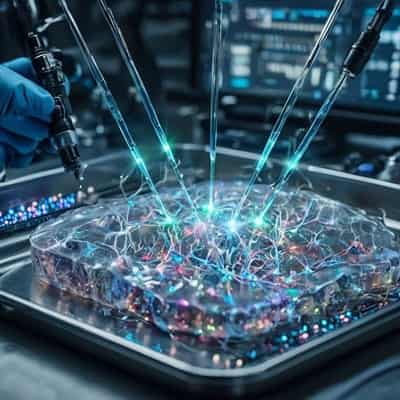

Long a revolutionary tool for neuroscience research, optogenetics, the technique of using light to control genetically modified neurons, is now making significant strides toward becoming a viable therapy for severe neurological conditions. Recent developments highlight promising applications for vision restoration, chronic pain, and epilepsy, moving beyond the laboratory and into human trials and advanced preclinical studies.
A landmark moment came in 2021 with the first reported success in a human. A patient with retinitis pigmentosa, having received a gene therapy to make retinal cells light-sensitive, regained the ability to locate objects using special goggles. This proof of concept has paved the way for expanded clinical exploration.
The field's progress is now being accelerated by next-generation light-sensitive proteins, or opsins. A key innovation is eOPN3, an inhibitory opsin derived from mosquitoes. This protein is highly sensitive, can be activated by tissue-penetrating red light, and works by naturally calming overactive neural circuits. Companies like Boston-based Modulight Biotherapeutics are leveraging eOPN3 to develop treatments for conditions like drug-resistant trigeminal (facial) pain and epilepsy, with plans to enter clinical trials.
Recent research underscores its potential. In a study presented at April 2025 conference, scientists used eOPN3 to suppress seizures in a pig model, an animal with a brain size and complexity closer to humans. Light delivery halted seizure activity within seconds, demonstrating a powerful therapeutic effect. Beyond epilepsy, researchers are investigating optogenetic approaches to help patients with ALS retain swallowing function and to treat movement disorders like Parkinson's disease with unprecedented cellular precision.
While challenges remain, including ensuring the long-term safety of gene delivery, the collective work represents a fundamental shift. As one neuroscientist noted, the goal is to move beyond broadly acting treatments and instead target "the right neurons, in the right place, at the right time".