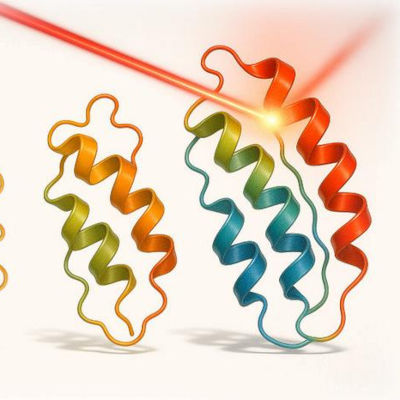

Scientists use directed evolution to create better proteins, such as enzymes and antibodies. These improved proteins appear in everyday items like laundry detergents, medicines, and industrial processes. However, traditional lab methods apply steady pressure to select proteins that are always highly active, which does not match how biology often works. Many proteins act like switches or logic gates - proteins that process multiple signals to make simple decisions - and they must change states over time, turning on briefly then off, for example. If evolution focuses only on one state, the protein might lose its ability to switch properly, harming cells or organisms.
To solve this, researchers at EPFL developed optovolution, a technique that uses light to direct the evolution of proteins with changing, multi-state functions. This approach mimics real cell operations where timing is key. They tested it in budding yeast by altering its cell cycle - the sequence of steps cells follow to grow and divide - so that it depended on the protein switching correctly between on and off. If the protein stayed in one state too long, the cell stopped growing or died. Using optogenetics - a method to control genes with light pulses - the researchers timed the protein's flips precisely during each 90-minute cell cycle, automatically selecting better versions without constant human checks.
Achievements with optovolution
With this system, the researchers evolved improved light-sensitive proteins, creating 19 new versions that respond better to light, stay less active in the dark, or react to green light instead of just blue - a color shift previously seen as very hard due to how proteins absorb light. They also adapted a red-light system to work without added chemicals by finding a mutation that lets it use molecules already in the cell. Beyond light sensors, optovolution created a protein that functions like a tiny computer, activating genes only when both a light and a chemical signal are present. These dynamic proteins are central to how cells sense, decide, and control actions, such as responding to stress or dividing. Optovolution could lead to smarter cell circuits, color-specific light controls for experiments, and deeper insights into how complex protein traits evolve, advancing synthetic biology, biotech, and basic science.
This research is published in Cell.