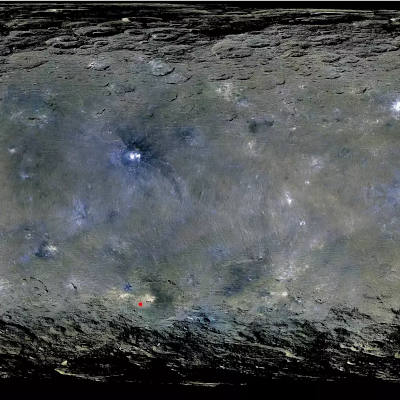

Organic material on the dwarf planet Ceres likely came from space, not from inside Ceres itself. Researchers at the Max Planck Institute for Solar System Research (MPS) used artificial intelligence (AI) to analyze data from NASA's Dawn spacecraft.
This research aimed to understand the origin of these organics, which are crucial for life. The researchers describe the methods and results of this study in a paper published in AGU Advances.
Organic molecules are compounds of carbon, hydrogen, and sometimes other elements, essential for life. On Ceres, these aren't from the planet's cryovolcanism, where salty water from below reaches the surface. Instead, they might have come from asteroids hitting Ceres from the outer asteroid belt. These impacts would not produce much heat, allowing organic materials to survive.
Ceres lies in the asteroid belt, between Mars and Jupiter, making it an interesting case for studying how organic materials spread in the Solar System. The NASA Dawn mission, which orbited Ceres from 2015 to 2018, used cameras and a spectrometer to map the surface. The spectrometer can split light to confirm organics, identifying aliphatic hydrocarbons, which are chain-like structures.
Organic molecules could be also in other places in the asteroid belt
AI helped scan Ceres' surface for these organics, showing they're mostly near the Ernutet crater. There's no sign of volcanic or tectonic activity at these sites, supporting the idea that these materials are from space impacts.
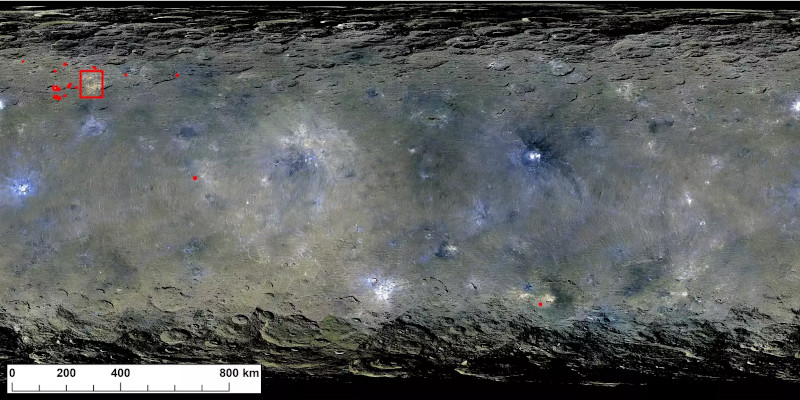
While Dawn can't detect all types of organics, there's a chance that life's building blocks were also made in Ceres' underground ocean. A future lander mission could provide more direct evidence of Ceres' internal organic material.
However, the organic deposits that the researchers found so far "likely do not originate" from Ceres itself,” says researcher Andreas Nathues in an MPS press release.
This seems to suggest that other places in the asteroid belt could have organic materials.