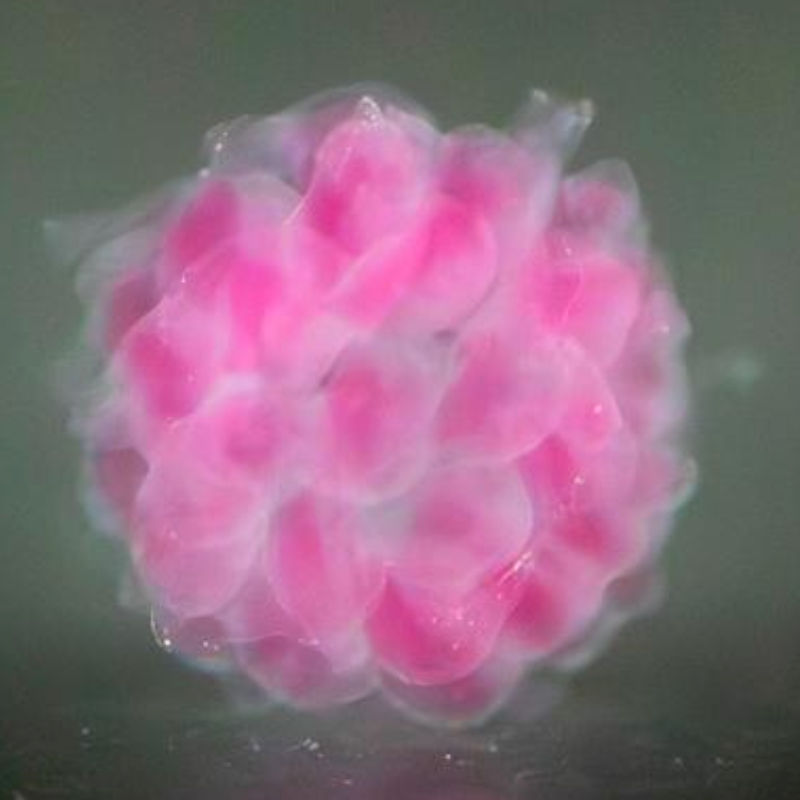

Researchers at the University of Virginia School of Engineering and Applied Science have developed what they believe could be the template for the first building blocks of human-compatible organs, printed on demand.
Their bioprinting "digital assembly of spherical particles" (DASP) method deposits particles of biomaterial in a supporting matrix (both water-based). This matrix allows for building 3D structures that provide a suitable environment for the cells to grow. (The assembly process uses “voxels,” the 3D version of pixels, to construct the 3D objects.)
DASP’s applications will include artificial organ transplant, disease and tissue modeling, and screening candidates for new drugs, according to the researchers.
Printing organoids
“For example, with this level of control, we could print organoids, which are 3D cell-based models that function as human tissue, to study disease progression in the search for cures,” said Liheng Cai, an assistant professor of materials science and engineering and chemical engineering, in a statement.
The particles are polymer hydrogels engineered to mimic human tissue by tweaking the arrangement and chemical bonds of single-molecule monomers, which link together in chains to form networks. The “double network” hydrogels—formed from two intertwined molecular networks—are mechanically strong but highly tunable for mimicking the physical characteristics of human tissue. The bioprinter uses a multichannel nozzle to mix the hydrogel components on demand.
The results were published July 13 in the journal Nature Communications.
Funding: National Science Foundation, the UVA LaunchPad for Diabetes, the UVA Coulter Center for Translational Research, Juvenile Diabetes Research Foundation, Virginia’s Commonwealth Health Research Board and the UVA Center for Advanced Biomanufacturing.
Citation: Zhu, J., He, Y., Wang, Y., & Cai, L. (2024). Voxelated bioprinting of modular double-network bio-ink droplets. Nature Communications, 15(1), 1-16. https://doi.org/10.1038/s41467-024-49705-z (open access)