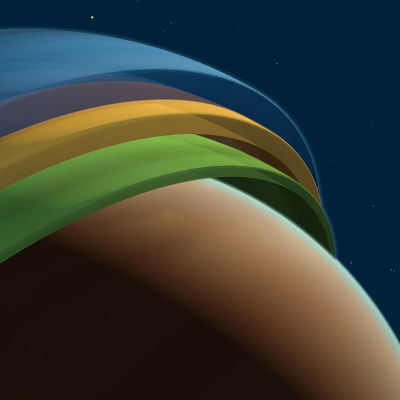

Astronomers recently studied the atmosphere of a faraway planet called WASP-121b, also known as Tylos. They used the Very Large Telescope (VLT) of the European Southern Observatory (ESO).
By linking its four big telescopes together, the astronomers mapped the planet’s atmosphere in 3D for the first time ever. They have published this study in Nature.
Tylos is 900 light-years away. It is an ultra-hot Jupiter, a giant gas planet super close to its star, making it hot on one side and cooler on the other.
The astronomers discovered wild winds blowing chemicals like iron and titanium around Tylos. These winds create weather patterns we don’t see on Earth. A jet stream, which is a fast-moving wind, whips around the planet’s middle. Another wind lower down moves gas from the hot side to the cold side.
It feels like science fiction
This is totally new and unlike any planet we’ve studied before. "It feels like something out of science fiction," says research leader Julia Victoria Seidel in a press release issued by ESO.
To figure this out, the astronomers used a tool called ESPRESSO on the VLT. It combines light from all four telescopes into one strong signal. This let them see faint details they couldn’t catch with just one telescope. They watched Tylos pass in front of its star, spotting chemicals at different heights in the atmosphere. Iron, sodium, and hydrogen showed how winds move in deep, middle, and shallow layers.
This kind of detailed look is tough even for space telescopes, so ground-based ones like the VLT are key.
The astronomers also found titanium hiding below the jet stream, which was a surprise since earlier studies missed it. It’s amazing we can learn about a planet so far away. To study smaller planets like Earth, though, we’ll need even bigger telescopes.
One called the Extremely Large Telescope, or ELT, is being built now in Chile. It’ll have a tool called ANDES to dig deeper into exoplanet atmospheres.