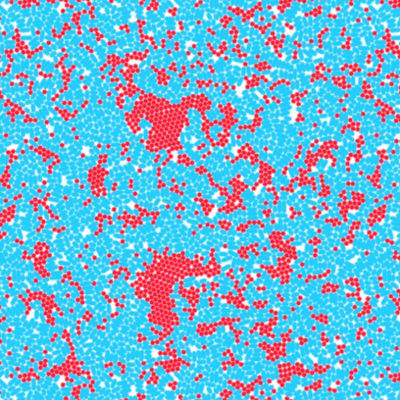

Researchers have discovered a new way that phase separation can happen. Phase separation is the spontaneous de-mixing of two substances, a process in nature that often creates structure and patterns. It normally needs some form of attraction between the parts involved. In this case the attraction comes not from direct forces between the particles but from the living environment around them.
Self-propelled particles are objects that move by themselves, such as crawling cells or miniature artificial agents. When these particles are placed inside a dense colony of cells that grow, divide and die, something unexpected occurs. The particles either spread out evenly through the colony or collapse into tight crystal-like clusters. The switch between these two states is sharp. Physicists call such a sudden change a phase transition.
The growing medium as a hidden force
Computer simulations showed how this works. A single self-propelled particle would normally travel in a straight line forever at constant speed. Inside the growing colony, however, dividing and dying cells constantly push it. These random pushes act like noise, making the path erratic. The dense medium also creates friction-like resistance that slows the particle and makes it change direction more often. As a result, the particle starts to behave like an active Brownian particle. This is a physics model for a self-moving object affected by random noise, friction and limited straight-line travel.
When two such particles come close together, they disturb the flow of growing cells in a shared way. This disturbance creates a statistical bias that gently pushes the particles toward each other. No real attractive force is added in the simulation, yet an effective attraction (the exact physical origin of which is still an open question) appears from the collective motion of the growing cells.
Surprisingly, it is the slower particles that form clusters. Faster particles escape the attraction more easily and stay spread out. This is the opposite of the usual pattern seen in other active systems. The findings could help explain behavior in bacterial biofilms, which are communities with mostly stationary growing cells mixed with some moving ones, and in tumors, where fast-dividing cells live alongside invasive moving cells.
This study is published in Physical Review Research.