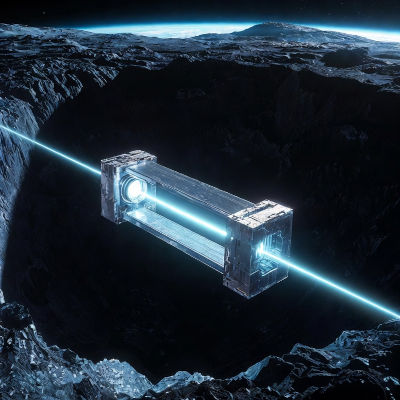

Physicists have suggested placing a special instrument inside some of the coldest and darkest places on the moon. These are craters near the moon's south pole that never receive sunlight and stay in permanent shadow.
The goal is to create a highly stable laser. To make the laser extremely stable, scientists want to use an optical silicon cavity. This is a block of silicon with mirrors at both ends. Light bounces back and forth between the mirrors, and only certain exact frequencies, or colors, of light are allowed to resonate inside.
The moon's permanently shadowed craters offer excellent conditions for this device. The temperature there is around 50 kelvins, which is very close to absolute zero. This extreme cold greatly reduces tiny movements in the mirrors caused by heat. The area also has almost no air and very little vibration compared to Earth.
The physicists have published this research in PNAS.
How the lunar laser system would work
Once placed in a crater, the optical cavity would help lock a regular laser to a very precise frequency. This stable laser could then serve as a reliable signal, similar to GPS, to help spacecraft land safely on the moon, especially in dark areas. It could also support highly accurate timekeeping and allow precise measurements of distances between objects on the lunar surface. In the future, a network of such lasers might even detect gravitational waves, which are tiny ripples in space-time caused by distant cosmic events.
The silicon cavity would be built on Earth and then taken to the moon by astronauts. It is small enough to fit inside a spacecraft. Researchers believe it could first be tested in low-Earth orbit within a few years and later deployed on the moon.
This idea could provide important infrastructure for future lunar exploration, including better navigation, Earth-Moon communication, and new physics experiments.