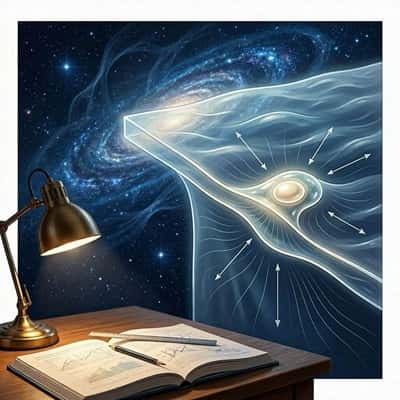

Researchers have introduced a novel dark matter candidate called the “Wallion”: an ultralight bosonic particle whose mass is exponentially suppressed by a hard boundary in its field space. Unlike axions, which live on a compact periodic landscape, wallions roam freely until approaching a limiting field value where the potential rises sharply, effectively confining them. [1]
Published in American Physical Society (APS), the study shows that this mechanism naturally produces an extremely light mass that remains stable against quantum corrections. The wallion can be produced via the misalignment mechanism in the early universe, and its relic density matches observed dark matter abundances across broad parameter ranges.
A key advantage is the suppression of isocurvature perturbations, a common problem for ultralight candidates, when the initial field displacement exceeds a critical value. The authors also demonstrate that the wallion potential can arise from instanton effects in a dark gauge sector, requiring only a quadratic coupling between the field and dark gluons.
If wallions couple weakly to photons via higher-dimensional operators, they become testable in upcoming experiments such as atom interferometers (AION, AEDGE). The framework offers a fresh approach to wave dark matter, distinct from axions and WIMPs, and opens new avenues for linking dark sector physics to observable signatures in cosmology and precision laboratories.