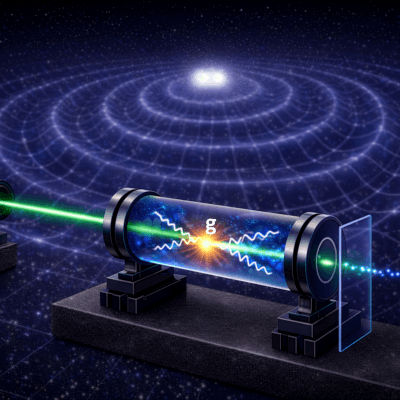

Modern physics faces a big challenge. Its two key ideas are quantum theory, which explains nature using particles and forces, and Einstein's general relativity, which sees gravity as a smooth bend in space and time. These do not fit together well. To join them, gravity must be quantum too, carried by gravitons - hypothetical bits that make up gravitational force. For years, experts thought finding gravitons was impossible, so quantum gravity stayed just a theory without real tests.
In 2024 a research paper published in Nature Communications showed that detecting gravitons could be possible. This comes from blending two recent successes. First, gravitational waves were predicted by Einstein long ago and first spotted in 2015. They are now seen often, giving a fresh look at the universe. If gravity is quantum, these waves are really huge groups of gravitons acting like smooth waves.
Second, quantum engineering lets scientists cool and control bigger objects in quantum states. In 2022, scientists controlled single vibrational quanta in superfluid helium, a liquid that flows without friction, weighing over a nanogram.
Building the first graviton detector
Researchers at Stevens Institute of Technology and Yale University think combining these techniques could catch a single graviton. A gravitational wave might pass one quantum of energy - a graviton - into a large quantum setup, and the tiny shift could be measured. With kilogram-sized quantum systems near strong waves from space crashes, this could work.
The researchers are making the world's first experimental setup for this. They use a centimeter-long resonator - a vibrating bar - in superfluid helium, cooled to its lowest quantum state. Lasers will spot phonons - vibrational quanta that gravitons turn into. Success could guide bigger versions to truly detect gravitons, starting real lab work on quantum gravity. The researchers note that quantum physics started with light and matter tests, and now gravity can join that experimental world, like early photon studies over a century ago.