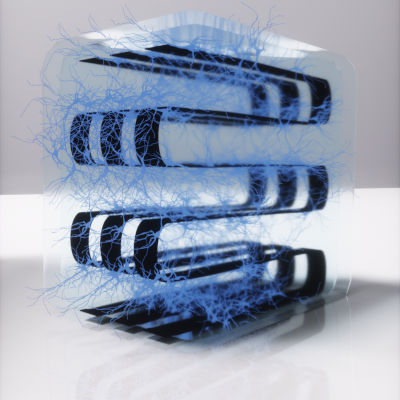

Princeton University scientists created a device that combines neurons with electronic components. Their approach builds the electronics first and lets the neurons grow inside the structure.
The device uses a flexible three-dimensional mesh made of microscopic metal wires and electrodes. A very thin epoxy coating supports the wires while allowing close contact with the soft neurons. Epoxy is a durable, insulating material. This mesh serves as a scaffold, a framework that supports cell growth. Tens of thousands of neurons grow around and through the mesh, forming a large living network.
The integrated design lets researchers record and stimulate the neurons’ electrical activity with high precision. The scientists monitored the system for more than six months. By strengthening or weakening connections between neurons, they trained the network to recognize patterns. In tests, the system successfully distinguished between different spatial patterns and different temporal patterns of electrical pulses. Spatial patterns relate to the location of signals, while temporal patterns relate to their timing.
Energy efficiency and neuroscience applications
The work, published in Nature Electronics, highlights a human advantage over current artificial intelligence (AI) systems. Modern AI requires large amounts of electrical power.
“The real bottleneck for AI in the near future is energy,” note the scientists. “Our brain consumes only a tiny fraction - about one millionth - of the power consumed by today’s AI systems to perform similar tasks.” This biological neural network could help address the growing energy demands of AI.
The device also offers new ways to study basic neuroscience questions. Researchers hope to scale it up for more complex tasks. In the future, such systems may contribute to understanding and treating neurological diseases, which affect the brain and nerves.
The scientists noted that these 3D biological neural networks can reveal how the brain computes while supporting medical research. The hybrid approach opens a path toward more efficient computing inspired by living brains.