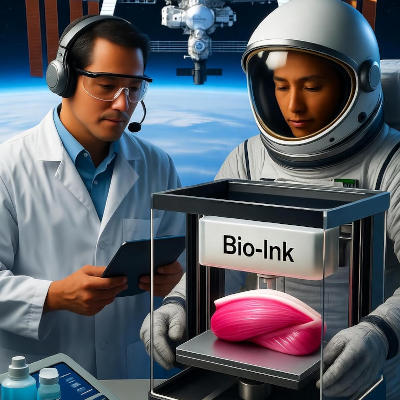

Astronauts face serious body weakening in space because of zero gravity. To help solve this, scientists are creating test models that mimic human muscles accurately. Researchers at ETH Zurich have used parabolic flights, which are airplane maneuvers that create short periods of microgravity, to test 3D printing of muscle tissue. This method lets them make tissue under conditions close to space, aiming to grow human parts in orbit for research on diseases and therapies.
On Earth, gravity makes it hard to print fine biological structures like muscle. 3D printers can use bio-ink, a mix of carrier material and living cells, but the weight causes structures to sag or cells to settle unevenly before hardening. This results in models that do not match real body parts well. In microgravity, these problems vanish, allowing muscle fibers to align naturally, which is key for reliable drug tests or disease studies.
A gravity-free printing breakthrough
The researchers created a new system called G-FLight, short for gravity-independent filamented light, which prints muscle quickly using a special bio-resin, a light-sensitive material with cells. During 30 parabolic cycles, they printed tissue in weightless moments. The microgravity versions showed the same cell survival rates and fiber counts as Earth-printed ones. The bio-resin also stores well long-term, suiting space missions.
The researchers have described the methods and results of this study in a paper published in Advanced Science.
"The G-Flight printing concept, together with the new resins enabling refrigeration or cryopreservation with encapsulated cells, offers a promising solution for biofabrication in space," notes the paper.
This advance helps tissue engineering, the field of building body parts, for space and medicine. In the future, on the International Space Station or other platforms, scientists could make complex organoids, which are mini-organs, to study issues like muscular dystrophy, a muscle-wasting disease, or space-caused muscle loss. These models, printed precisely in zero gravity, better copy human complexity for testing treatments.