
Physicists would like to unify two major theories: quantum physics, which describes elementary particles and fields with the exception of gravity, and general relativity, which describes gravity as a four-dimensional fabric combining space and time, curved by large masses like stars. These theories do not yet combine well, and ideas like string theory or loop quantum gravity lack clear tests.
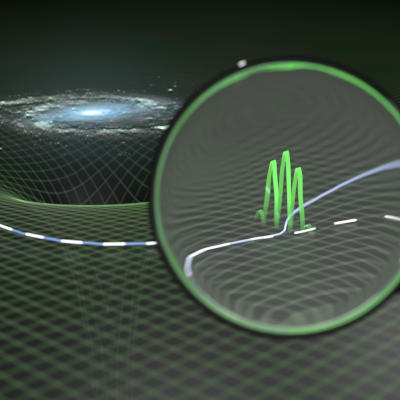
Researchers at TU Wien have proposed a new method by examining geodesics, the shortest paths objects follow in curved space-time, such as Earth's orbit around the Sun. They applied quantum rules to the metric of general relativity, a mathematical tool measuring space-time curvature, making it fuzzy like quantum positions or speeds, where exact values are replaced by probabilities.
This creates a quantized metric, leading to the q-desic equation, which predicts slight deviations from classical geodesics due to quantum effects.
Quantum deviations at cosmic scales
In normal gravity, these deviations are tiny, about 10^(-35) meters, too small to measure. But including the cosmological constant - also called dark energy, a force driving the universe's expansion - changes this. Deviations grow large at cosmic scales, like 10^(21) meters, affecting puzzles such as the rotation speeds of spiral galaxies, where stars move faster than expected without extra matter.
While Earth-Sun orbits show no difference, large-scale observations could reveal quantum gravity's influence. This approach provides a testable "slipper" to identify the right theory, like in the Cinderella tale, by comparing particle paths in space. It opens doors to analyzing cosmic data in new ways, potentially solving important issues without needing huge experiments.
“At first I would not have expected quantum corrections on large scales to produce such dramatic changes,” says research leader Benjamin Koch in a press release.
Future work will refine this to fit more gravity cases, helping distinguish viable quantum gravity models.
The researchers have described the methods and results of this study in a paper published in Physical Review D.