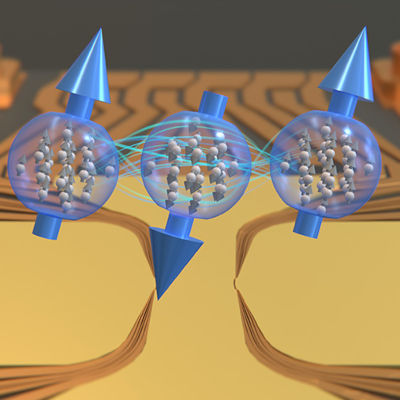

Scientists from the University of Basel and the Laboratoire Kastler Brossel in Paris used entanglement to improve measurements of multiple physical values at once. They focused on quantum metrology, which is the use of quantum features to make more precise readings of quantities like fields or forces.
“Quantum metrology, which exploits quantum effects to improve measurements of physical quantities, is by now an established field of research,” says research co-leader Philipp Treutlein in a press release.
Earlier studies entangled spins of cold atoms - tiny magnetic directions like compass needles - in one spot to measure spin directions better. But here, they took it further by creating entanglement in one cloud of atoms and then splitting it into up to three separate clouds.
This setup lets the entanglement work over distances. For example, to map an electromagnetic field, the scientists used these separated entangled spins. The entanglement cuts down on quantum noise, the random uncertainty from quantum rules, and cancels out other equal disturbances on all atoms.
Extending entanglement to separated atoms
No one had done this kind of measurement with spread-out entangled atom clouds before, and the theory was unclear. The researchers first entangled spins in a single cloud, then divided it into entangled parts. With just a few tests, they mapped the field more precisely than without the spatial link.
This method has real uses. In optical lattice clocks, atoms trapped in laser grids act as super-accurate timekeepers; entanglement could reduce errors from atom spread, sharpening time readings. In interferometers that detect gravity changes, it could better measure gravity variations for tasks like mapping underground features.
Overall, this advance shows how quantum links at a distance can push measurement limits, aiding fields from timekeeping to sensing Earth's pull.
The scientists have described the methods and results of this study in a paper published in Science.