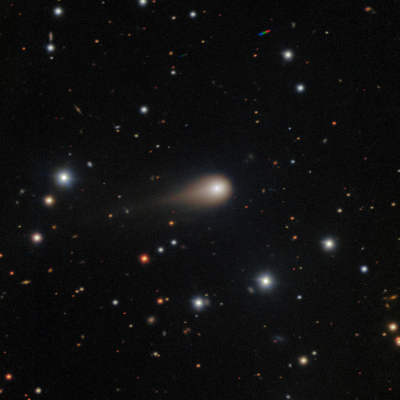

The interstellar object 3I/ATLAS, discovered in July, has captured global attention as the third confirmed interstellar object to visit our solar system. Originating from beyond our stellar neighborhood, this massive object - estimated to be several kilometers wide - has fueled scientific excitement and public speculation.
In late October 2025, 3I/ATLAS made its closest approach to the Sun (perihelion), where it accelerated and developed a striking blue glow. Astronomers attribute this coloration to its cometary coma - a glowing envelope of gas and dust - actively shedding material under intense solar heating.
Observations from the James Webb Space Telescope (JWST) revealed that billions of years of cosmic radiation exposure have chemically altered the object's surface, transforming its composition in ways not seen in solar system comets. This "mysterious light" has puzzled researchers, with some speculating on exotic processes at play.
The comet's passage has sparked an "interplanetary race" among space agencies. NASA's monitoring indicates it will remain visible to ground-based telescopes until September 2026, but it temporarily vanished from Earth's view in late October due to solar proximity. The European Space Agency (ESA) seized the opportunity, using its ExoMars Trace Gas Orbiter and Mars Express spacecraft to observe 3I/ATLAS from around Mars, capturing data on its composition and trajectory while Earth-based views were obscured.
Alien origins?
Public interest peaked with Elon Musk's comments on November 2, where he weighed in on Harvard astronomer Avi Loeb's suggestion of possible alien origins for such objects. By the date of its perihelion, 3I/ATLAS displayed the first evidence of a non-gravitational acceleration, Loeb claimed. Musk highlighted the hypothetical devastation if 3I/ATLAS were to impact Earth, noting it could "obliterate a continent" due to its size and speed - though he emphasized no collision risk exists. The object is set to fly by Earth in early December 2025, at a safe distance of about 0.3 astronomical units, offering prime viewing opportunities for amateur astronomers.
Scientists view 3I/ATLAS as a time capsule from another star system, potentially revealing clues about exoplanetary formation. Ongoing analyses could reshape our understanding of interstellar visitors, with more data expected as it reemerges in December skies.