
Scientists at Ulsan National Institute of Science and Technology (UNIST) have created an ultra-low-power artificial synapse that fully biodegrades in soil, marking a significant advance for sustainable "brain-like" computing.
The device mimics the brain's method of processing information by using ions, much like biological neurotransmitters. This design allows it to achieve an energy efficiency surpassing that of nature, consuming a record-low 0.85 femtojoules per operation which is less than a biological synapse.
Equally significant is the device's longevity and final fate. It can retain a memory state, a key feature for learning, for nearly 100 minutes (5,944 seconds). After use, the entire structure, made from natural polymers like chitosan (from crab shells) and cellulose acetate, decomposes in soil within 16 days, addressing the growing problem of electronic waste.
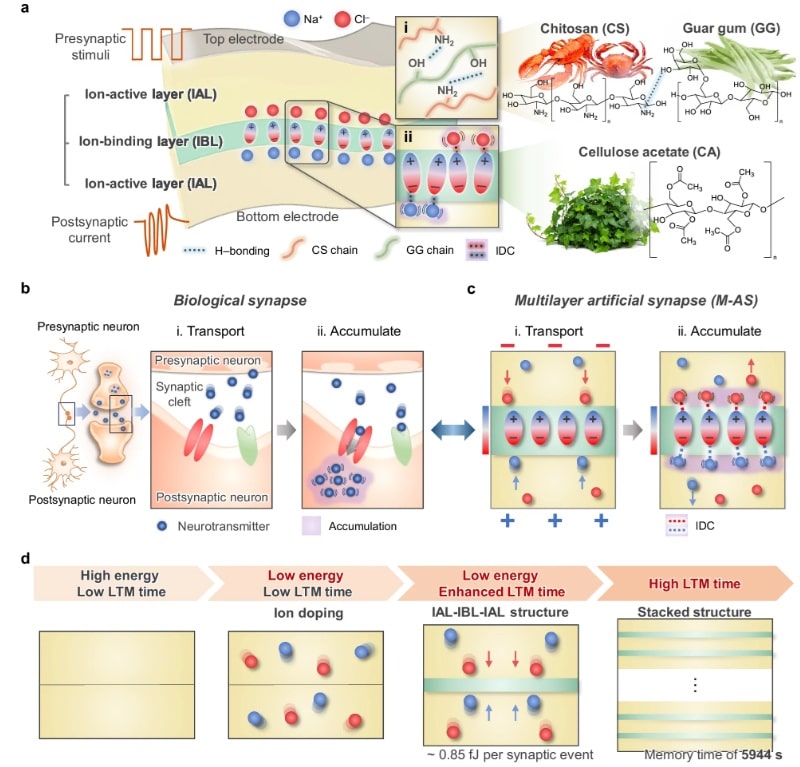
In the above figure: a Schematic of the M-AS with an IAL–IBL–IAL multilayer configuration: (i) crosslinked CS–GG IALs via hydrogen bonding between –OH and –NH₂ groups of CS and GG, and (ii) IDC at the IAL–IBL interface. b Schematic illustration for the working mechanism of a biological synapse: (i) neurotransmitter transport under presynaptic stimuli and (ii) ion accumulation inside the postsynaptic neuron. c Working mechanism of the M-AS: (i) ion transport under a presynaptic voltage pulse, and (ii) ion accumulation via IDC after stimulus. d Design strategies for achieving low energy consumption and long LTM time in the artificial synapse: ion doping, incorporation of an IBL, and multilayer stacking of IAL–IBL layers for extended LTM.
Researchers demonstrated its practical potential in a simple robot. When the synapse detected a heat signal, it triggered a reflex-like action, causing a robotic hand to pull away from a hot object. This showcases a path toward temporary, eco-friendly intelligent devices for environmental monitoring or medical implants that safely dissolve in the body.