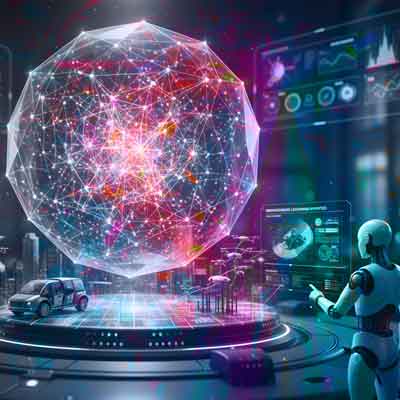

Imagine a world where intelligent software agents autonomously navigate, understand, and interact with complex digital landscapes without constant programmer intervention. This vision is compelling, yet engineering such adaptable agents remains a fundamental challenge in artificial intelligence. The principal obstacles are clear: agents must efficiently process hyper-verbose web data and dynamically integrate with evolving web services and devices. These issues impede progress, stalling the adoption of scalable and resilient automation. The latest research addresses these problems by introducing robust design patterns and frameworks that support agents in constructing unified world models. This presents a scientific account of these solutions, emphasizing their theoretical foundation and practical impact.
Structured Perception: The DOM Transduction Pattern
Agents operating in web environments face the critical problem of perception. The raw Document Object Model (DOM) of modern web pages is overwhelming; up to 90% of HTML tokens are non-semantic, including scripts and trackers. When passed to large language models (LLMs), such excess not only degrades reasoning but also inflates computational costs. Researchers formalize this challenge as one of representation, where an agent’s cognitive capacity is mismatched with the raw complexity of its observation space.
To overcome this, researchers have introduced the DOM Transduction Pattern. At its core is an architectural component known as the DOM Transformer, embedded within the agent’s perception module. This transformer executes a systematic cleaning and pruning of the DOM, removing irrelevant tags and employing block-tree segmentation algorithms. The system then compacts the cleaned structure using token-efficient encodings, such as Emmet Notation, and cascades smaller LLMs to summarize and distill complex content for downstream decision-making. Experimentally, such pattern-based preprocessing has demonstrated significant gains in reliability, cost reduction, and agent performance. Pruning strategies must be finely tuned, as over-aggressive simplification can inadvertently eliminate critical interactive elements, while insufficient cleaning leaves agents encumbered by noise.
Dynamic Adaptation: The Hypermedia Affordances Recognition Pattern
Interoperability and adaptability present a second, equally formidable challenge. As digital ecosystems integrate distributed services and IoT devices, hardcoded interfaces become fragile and inefficient. Agents must dynamically discover and assimilate capabilities known as affordances of new services in real-time.
Employing the principles of hypermedia multi-agent systems, specifically the HATEOAS (Hypermedia as the Engine of Application State) constraint, the Hypermedia Affordances Recognition Pattern provides a solution. Here, agents’ interface with resources exposing standardized, machine-readable semantic descriptions, most notably the W3C Web of Things Thing Description (TD) in JSON-LD format. The agent’s affordance parser processes TDs, extracting properties, actions, and protocol bindings. This enables agents to autonomously interact with new devices and services without prior knowledge or static dependencies. The architectural constraints demand that interaction protocols and affordances are driven entirely by externally provided descriptions rather than internal agent configuration.
Implementation requires service providers to carefully construct and maintain Thing Descriptions. Correct deployment ensures exceptional agent adaptability; however, poorly defined interfaces can propagate errors. Practical deployments leverage affordance parsing via JSON-LD libraries, and service discovery via standardized WoT directories.

Unified Cognitive Mapping: Fusion for Enhanced Agent Intelligence
The scientific significance of these patterns lies in their complementary action. DOM Transduction empowers agents to distill complex environments into actionable representations, while Hypermedia Affordances Recognition lets agents extend their world models with new capabilities. Together, they enable unified cognitive mapping: a process where distinct perceptual streams DOM segmentation, service contracts, affordance descriptions converge to form a semantically rich, updatable world model. This integration drives advancements in predictive reasoning and autonomous planning for digital agents.
An illustrative application involves an agent negotiating a hotel booking. The DOM Transduction Pattern parses and simplifies the booking site, enabling efficient reasoning and decision-making. Upon encountering smart room controls, the agent employs Hypermedia Affordance Recognition, parsing a Thing Description to dynamically learn device protocols—such as setting room temperature—thus enriching its cognitive map on the fly.
Conclusion
This presents an innovative, scientifically validated framework for constructing and maintaining actionable world models in autonomous agents. By formalizing problems and solutions through architectural design patterns, researchers enable agents to efficiently perceive web environments and dynamically interact with new resources. The implications are significant: improved scalability, enhanced resilience, and future-proof automation. Moving forward, the envisioned integration of structured and visual perceptual methods promises the development of multimodal agents capable of human-level competence in diverse digital landscapes. These scientific advances mark a pivotal step for AI researchers and practitioners striving to realize robust, adaptive software agents.
