
Researchers at Harvard John A. Paulson School of Engineering and Applied Sciences have demonstrated for the first time that a single quantum of vibrational energy can interact with a single atomic spin. A quantum is the smallest possible unit of energy or information. The results are published in Nature.
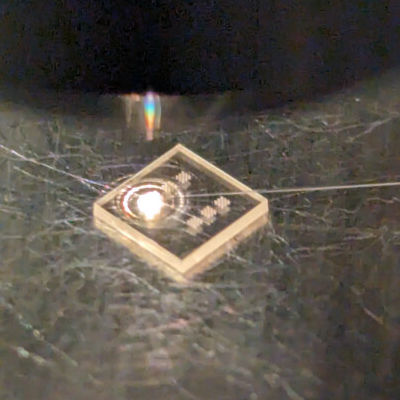
The researchers engineered a nanometer-scale mechanical resonator around a single color-center spin qubit inside a diamond chip. A mechanical resonator is a tiny vibrating structure, like a miniature tuning fork only billionths of a meter across. Color centers are atomic defects in the diamond crystal structure. A spin qubit is a basic unit of quantum information carried by the magnetic property of a single atom. These color centers can store quantum information for use in future quantum computers or sensors.
A phonon is the smallest possible unit of sound or mechanical vibration. When one phonon interacts with the spin qubit, it can change the qubit’s quantum state. This strong spin-phonon coupling solves a major challenge in the field and allows reliable quantum information storage.
Strong interaction between vibration and quantum memory
Mechanical vibrations can remain stable for a long time while occupying a very small space. This combination makes phonons promising as carriers of quantum information. They could serve as interconnects that link compact quantum memories, processors, and sensors on future quantum chips. Many different quantum systems, including superconducting qubits and quantum dots, already interact strongly with phonons. Quantum acoustics therefore offers a possible universal way to connect these varied systems into larger hybrid devices.
The spin qubit also acts as an extremely sensitive probe of its surroundings. It can detect tiny forces, stresses, or temperature changes by sensing quantum-level vibrations in the device. The experiment shows improved control over quantum defects in solid materials and brings spin-mechanical systems closer to the stability needed for practical use. It represents an important step toward quantum acoustic devices that rely on sound rather than light or electricity. Such devices could enable new forms of quantum computing, communication, and ultra-precise sensing.