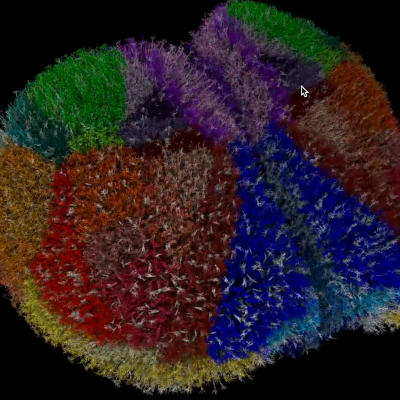

Researchers have created a highly detailed computer model of the entire cortex, which is the outer layer of the brain, in a mouse. This virtual copy includes almost ten million neurons and 26 billion synapses. It also links 86 different brain areas.
The model is biophysically realistic, meaning it copies real biological processes like ion flows, the movement of charged particles, and changes in membrane voltage, the electrical difference across cell walls. This allows scientists to simulate diseases such as Alzheimer's, a condition that causes memory loss, or epilepsy, seizures from abnormal brain activity, and see how problems spread through neural networks, groups of connected neurons.
The work uses Fugaku, a supercomputer in Japan that performs quadrillions of calculations per second. Scientists from the Allen Institute provided data on brain structure and cell types, while others handled the computing. The model lets researchers test ideas about brain function, like how brain waves affect attention or how seizures move, without using real animals. Before, such studies needed physical experiments one at a time. Now, virtual tests can reveal how issues start early and try out treatments safely.
A milestone in brain simulation
This achievement shows that large, precise brain models are possible with enough computing power. The simulation runs on tools like the Brain Modeling ToolKit, software for building brain models, and Neulite, a program that makes neurons act like real ones by solving equations for their signals. It captures details down to neuron branches and electrical flows. Researchers aim to expand to full mouse brains and eventually human ones. As one scientist noted, this opens doors to understanding the brain by building digital versions, helping solve mysteries of cognition, awareness of thoughts, and consciousness.
The researchers have described this virtual brain simulation in a paper presented at the SC25 supercomputing conference.