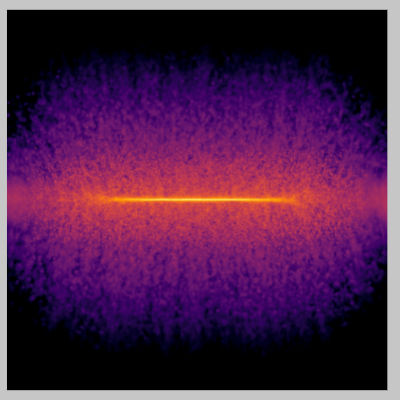

Researchers have made a computer model of the Milky Way galaxy that shows more than 100 billion single stars over 10,000 years. They used artificial intelligence (AI) along with number-based computer simulations. This model has 100 times more stars than older ones and was made 100 times quicker. It was shown at a big computing meeting and helps in space science, fast computing, and AI. The method could also model things like weather and climate changes.
Space scientists want to model galaxies to check ideas about how they form, their shape, and how stars change. Good models must include gravity, fluid dynamics, supernova explosions, and element synthesis. These happen on very different sizes and times, making it hard.
Old models could not show single stars in big galaxies like the Milky Way. They used groups of stars, each like 100 suns, so small events were averaged out. The problem is the time steps in simulations - short steps are needed for quick changes like supernovae, but they take lots of computer time and power.
A breakthrough with AI
To fix this, the researchers used a deep learning surrogate model (an AI that copies real physics quickly). It was trained on detailed supernova models to guess how gas spreads after an explosion in 100,000 years, without slowing the whole simulation. This lets the model handle big galaxy movements and small events at once. The researchers checked the model on supercomputers.
Now, modeling 1 million years takes only 2.78 hours, so 1 billion years would take 115 days, not 36 years like before. This could change simulations in other fields that link small and big scales. The lead researcher says mixing AI with fast computing changes how we solve complex science problems, and it helps find how life's building blocks formed in our galaxy.
The researchers have published the methods and results of this study in a conference paper.