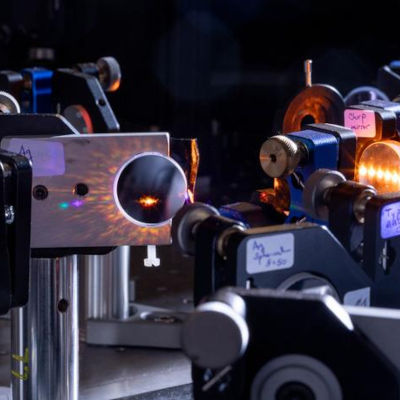

A group of scientists from the Politecnico di Milano in Italy has taken a major step toward computers that work at the speed of light, proving that extremely short pulses of light can carry out logical operations inside a material. These operations happen so quickly that they exceed the limits of current electronic devices. Today’s computers move electric charges through tiny switches (transistors). The new approach replaces electricity with light, which can change the state of electrons almost instantly.
The researchers used a special material known as tungsten disulfide. This two-dimensional semiconductor is only three atoms thick. In such thin layers, electrons can sit in two separate energy states called valleys. These valleys act like the zeros and ones in ordinary computer bits but can be switched far more rapidly. By sending a careful sequence of laser pulses, each lasting just a few femtoseconds, the scientists turned the valleys on, off, or expanded them. This allowed them to perform basic logical tasks, exactly as electronic circuits do, but at much higher speeds.
Faster than modern electronics
The operations run above 10 terahertz. One terahertz equals one trillion cycles per second, making the process over a hundred times faster than the best modern electronics. All of this works at ordinary room temperature with laser equipment already common in laboratories. The study also measured how long the information in the valleys stays stable, an important detail for building future devices.
Looking ahead, the work opens the door to a new class of ultra-fast logic components. Further advances will be needed to create more complex pulse sequences and increase the number of information units. These improvements could one day lead to information-processing technologies hundreds of times quicker than those used now.
The scientists have described the methods and results of this study in a paper published in Nature Photonics.