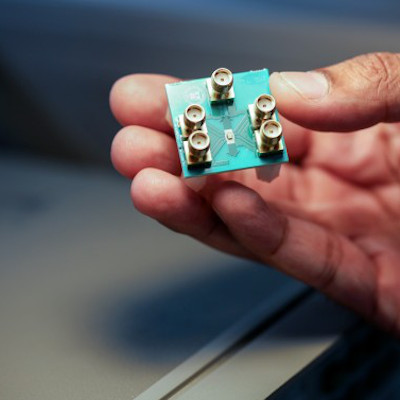

Scientists at Cornell University have made a small microchip, dubbed a microwave brain. This is the first processor that can handle both very fast data signals and wireless communication signals. It uses the physics of microwaves to do computations.
The chip is described in a paper published in Nature Electronics. It works as a microwave neural network and it is built entirely on a silicon microchip. The chip does real-time calculations in the frequency domain, for jobs like decoding radio signals, tracking radar targets, and processing digital data. It uses less than 200 milliwatts of power, which is a very small amount, like a fraction of what a light bulb needs.
The chip can be used for different computing tasks. It skips many steps that regular digital computers must do. Unlike normal neural networks that use digital steps timed by a clock, this uses analog methods and nonlinear behavior in the microwave range. This lets it manage data at speeds of tens of gigahertz, a measure of billions of cycles per second, much faster than most digital chips.
Innovative design for efficiency
The design throws out usual circuit rules to create a mix of frequency behaviors that give strong performance. The chip handles simple logic tasks and harder ones like spotting bit sequences or counting in fast data. It reaches 88 percent accuracy or more on classifying wireless signals, matching digital networks but with far less power and size. In regular digital systems, complex tasks need more parts, power, and fixes for errors. This chip uses a probabilistic approach, meaning it relies on probabilities, to keep accuracy high without extra costs.
The chip is very sensitive to inputs, making it good for security, like detecting oddities in wireless signals over many frequencies. The scientists think it could go to edge computing, which is processing data near where it is made, like on a smartwatch or phone, without needing distant servers. Though still in testing, they see ways to make it more accurate and fit it into current systems.