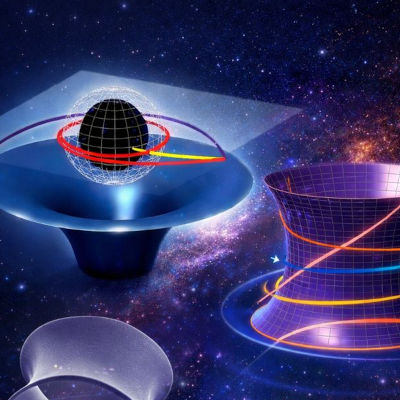

Scientists have created a small optical system that copies important behaviors of black holes in a laboratory. Researchers at Bar-Ilan University built tiny curved structures using 3d printing. These structures guide light in ways that match how waves move near a black hole after it collides or merges with another.
The system reproduces ringdown signals, which are the fading vibrations left after such cosmic events. These signals are the same kind detected by large instruments like LIGO, the laser interferometer gravitational-wave observatory that measures ripples in spacetime caused by distant black hole mergers. In the lab setup, light not only follows similar wave patterns but also produces laser emission, or focused light output.
This tabletop approach allows direct study of black hole physics that is normally impossible to observe up close. Quasinormal modes are the natural vibration frequencies of a disturbed black hole, similar to the ringing of a bell. The experiment clearly shows these modes, including those linked to the photon sphere, an unstable region around a black hole where light can orbit temporarily.
Tabletop recreation of extreme cosmic physics
The work demonstrates that the curved geometry of spacetime alone can trap and confine light without traditional mirrors. Researchers combined theory, computer simulations, and actual laser tests, and the results matched closely. The study opens new ways to explore general relativity, the theory describing gravity and spacetime, as well as to design novel light-based devices. It combines optics, which is the science of light, with ideas from astrophysics and advanced fabrication.
Future steps include testing more complex shapes, such as those of spinning black holes, and examining interactions between different vibration modes. The research, published in Advanced Science, received support from several Israeli and international science foundations and involved cooperation with scientists in France. It highlights how laboratory optics can bring distant universe phenomena within experimental reach.