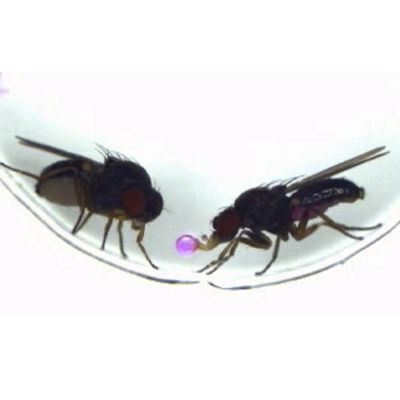

Scientists in Japan have changed the genes of fruit flies to move a special courtship behavior from one species to another. Courtship means the actions animals take to attract a mate.
They focused on two types of fruit flies: Drosophila melanogaster, which usually sings by vibrating its wings, and Drosophila subobscura, which gives a food gift by regurgitating, or spitting up, a drop of food for the female. These species split apart about 30 to 35 million years ago and use different ways to court, controlled by a gene called fruitless, or fru for short. Fru is a gene that directs male courtship actions.
In the gift-giving flies, certain brain cells that produce insulin connect to the brain's area that manages mating behaviors. In the singing flies, these cells do not connect. By turning on the fru gene in the insulin-producing neurons of the singing flies, the scientists made these cells grow long extensions called neural projections. These new connections formed fresh brain circuits, allowing the singing flies to start giving food gifts during courtship for the first time.
Discovering the role of specific neurons
To find this out, the scientists put special DNA into embryos of the gift-giving flies. This DNA let them use heat to turn on proteins in chosen brain cells. They heated the flies and watched which ones regurgitated food. This helped identify 16 to 18 insulin-producing neurons in a brain area called the pars intercerebralis. These neurons make a male-specific protein called FruM, which is key to the behavior.
The study shows that new behaviors in evolution do not need brand-new brain cells. Instead, small gene changes in existing neurons can lead to different actions, helping species adapt and become distinct. Evolution is the process where species change over time. The scientists traced this gift-giving back to its genetic start, explaining how nature builds new survival strategies.
This research, done by experts at the National Institute of Information and Communications Technology and Nagoya University, is published in Science.