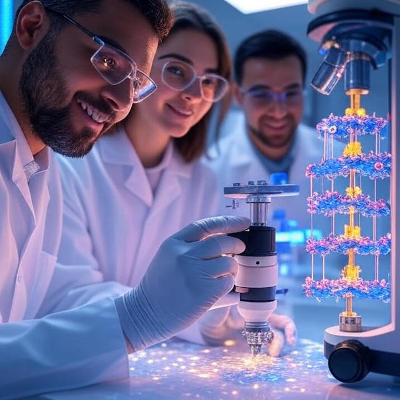

Biology and quantum technology often seem like opposites. Yet quantum mechanics underpins all matter, including in biology. Scientists at the University of Chicago have made a key advance by turning a protein from living cells into a qubit. A qubit is the basic unit of quantum computing.
This protein qubit acts as a quantum sensor and could give deep insights into how biology works. The scientists used a natural protein and turned it into a qubit. This approach lets cells build the qubits themselves, placing them exactly where needed and sensing much stronger signals than current quantum sensors.
The work is published in Nature. Unlike qubits from engineered materials, these protein versions can be made by cells and positioned with atomic accuracy. In the future, they might enable nanoscale magnetic resonance imaging (MRI) at the tiny level of cell parts. This could reveal the structure of cellular machines and change biological research. Beyond that, protein qubits might improve quantum tech overall by using nature's ways of evolving and assembling materials.
A new way to blend quantum and biology
Current spin-based quantum tech, which uses particle spins like tiny magnets for information, faces limits that nature's methods might overcome. The scientists turned a genetically encoded fluorescent protein into a quantum sensor. This method should work for many proteins, opening new research paths.
Now, researchers can measure quantum properties directly in living systems. The protein qubits are not as sensitive yet as top quantum sensors. But since they can be coded into genes and placed in living things, they offer a bold new way to observe biology at the quantum level, from how proteins fold into shapes to enzyme actions, which speed up chemical reactions, and early disease signs.
The researchers note the project's challenges and the need for persistence. This work thrives in settings that mix quantum engineering, building quantum devices, and molecular biology, studying molecules in life. It signals a time when quantum physics and biology merge, leading to major discoveries.