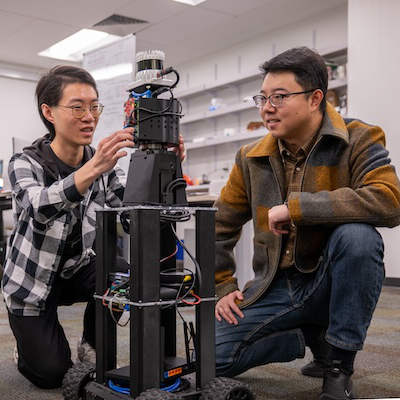

Robots often struggle to see and navigate in harsh conditions like fog or smoke because their usual vision tools, like cameras or LiDAR, depend on light. LiDAR works by sending out laser light and measuring the time it takes for that light to bounce back, but it doesn't work well when visibility is poor.
In nature, animals like bats use sound echoes to find their way in the dark, and sharks sense electrical fields to locate prey. These examples show that there are other ways to "see" besides light.
Researchers at the University of Pennsylvania have developed PanoRadar, which uses radio waves. Radio waves are much longer than light waves, so they can go through smoke, fog, and even some solid materials. Traditional radar, which also uses radio waves, gives rough images but can see through obstacles. PanoRadar takes this a step further by producing detailed 3D images.
Very clear pictures without light
PanoRadar works like a lighthouse, spinning around and sending out radio waves, which then bounce back to give information about the surroundings. Unlike the simple radar, PanoRadar uses smart math and AI to look at these reflections from many angles at once. This process creates a very clear picture, almost as good as what you'd get from LiDAR, but without needing light.
A challenge was making sure the images stay sharp even when the robot moves. Another challenge was to teach PanoRadar to recognize patterns in indoor spaces to understand what it's seeing, much like how a child learns to recognize objects.
PanoRadar has been tested in real buildings, where it showed it could see through smoke and even see things like glass walls that LiDAR usually misses. This ability to detect finer details, like people, makes it useful for tasks where seeing clearly through tough conditions could save lives, like in rescue missions or with self-driving cars.
The future might see PanoRadar working alongside other sensors, like cameras and LiDAR, to make even smarter robots that can tackle any environment by using the best features of each sensing method.