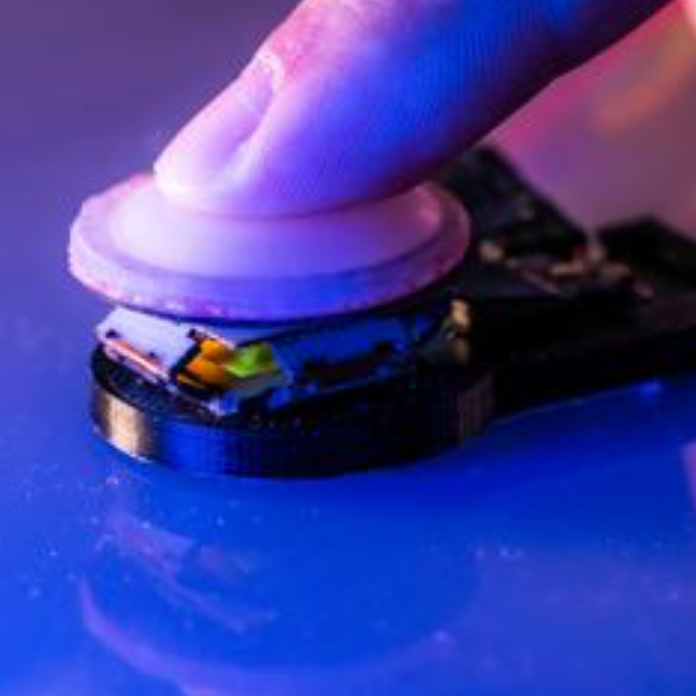

EPFL researchers have developed a haptic (relating to the sense of touch) technology that is capable of reproducing the softness of materials ranging from a marshmallow to a beating heart —overcoming a deceptively complex challenge that has previously eluded roboticists.
The perception of softness plays a crucial role in many actions and interactions—from judging the ripeness of an avocado to conducting a medical exam, or holding the hand of a loved one. But understanding and reproducing softness perception is challenging, because it involves so many sensory and cognitive processes.
Softness Rendering Interface
Previous attempts have not distinguished between two primary elements of softness perception: cutaneous cues (sensory feedback from the skin of the fingertip), and kinesthetic cues (feedback about the amount of force on the finger joint).
Now researchers at the Reconfigurable Robotics Lab (RLL) in EPRL's School of Engineering have done just that.
A softness interface
With SORI (Softness Rendering Interface), they were able to decouple cutaneous and kinesthetic cues for a range of real materials.
The research appears in the Proceedings of the National Academy of Science (PNAS).
We feel softness differently, dependng on skin contact
Neuroscientific and psychological studies show that cutaneous cues are largely based on how much skin is in contact with a surface. A surface that envelopes a greater area of your fingertip will be perceived as softer.
The reseachers developed parameters for the geometries of a fingertip and its contact surface to estimate the softness cues for that fingertip and extracted the softness parameters from a range of different materials. Then they mapped both sets of parameters onto the SORI device.
Creating softness for a range of materials
With this novel decoupling of kinesthetic and cutaneous functionality, SORI succeeded in recreating the softness of a range of materials—including beef, salmon, and marshmallow over the course of several experiments with two human volunteers.
It also mimicked materials with both soft and firm attributes (such as a biscuit on top of a marshmallow, and the sensation of a beating heart).
A wide range of robotic applications
Medicine is a primary area of potential application for this technology. For example, to train medical students to detect cancerous tumors, or to provide crucial sensory feedback to surgeons using robots to perform operations.
Other applications include robot-assisted exploration of space or the deep ocean, where the device could enable scientists to feel the softness of a discovered object from a remote location.
SORI is also a potential answer to one of the biggest challenges in robot-assisted agriculture: harvesting tender fruits and vegetables without crushing them.
Citation: Mete, M., Jeong, H., Wang, W. D., & Paik, J. (2024). SORI: A softness-rendering interface to unravel the nature of softness perception. Proceedings of the National Academy of Sciences, 121(13), e2314901121. https://doi.org/10.1073/pnas.2314901121

