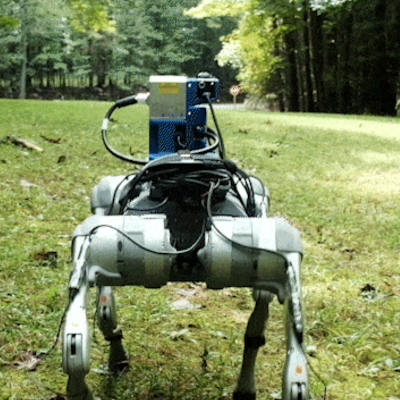

Duke University researchers created WildFusion, a new system that helps robots move through tricky outdoor places like forests. Humans use senses like touch, smell, hearing, and balance to walk easily on a hike. Robots usually depend only on cameras or LiDAR, a tool that measures distances with lasers. These tools struggle in messy places with trees, logs, or uneven ground. WildFusion changes this by combining sight, sound, touch, and balance, letting robots sense the world more like people do. The system, presented at a robotics conference in 2025, works on four-legged robots.
WildFusion uses an RGB camera for color images and LiDAR for mapping distances. It also has contact microphones, which pick up vibrations like the crunch of leaves or squish of mud. Tactile sensors feel how much force each foot uses, showing if the ground is stable or slippery. Inertial sensors measure wobbling or tilting, helping the robot stay balanced. These sensors give the robot a fuller picture of its surroundings.
Smarter Navigation with Deep Learning
A deep learning model powers WildFusion. It uses implicit neural representations, a method that sees the environment as smooth surfaces, not just points. This helps the robot decide where to step, even if its view is blocked. The system processes all sensor data into one clear map, filling in gaps when information is missing, much like humans guess a path in a forest.
Researchers tested WildFusion at Eno River State Park in North Carolina. The robot moved through dense forests, grasslands, and gravel paths, choosing safe routes through tall plants. The researchers say WildFusion helps robots work in unpredictable places like disaster zones. It solves problems when sensor data is unclear.
The researchers plan to add sensors for heat or humidity to improve WildFusion. Its design allows use in many areas, like checking remote buildings or exploring new places. WildFusion marks a step for robots to adapt and move confidently in tough environments.