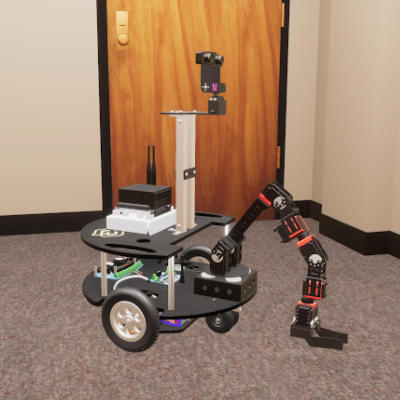

A small robot named Armstrong, about the size of a large pizza, moves on three wheels. The robot, developed by researchers at CU Boulder, has an arm with a claw to pick up objects, like a plastic block, and place them down. This simple setup is part of a new idea for exploring space, where robots and humans work together to build things like science stations or places for people to live on the moon.
Operators control Armstrong from another room using virtual reality (VR) goggles, which let them see through a camera on the robot. They find it feels very real, almost like being next to the robot. Researchers are studying how people on Earth can practice operating robots for the moon, where gravity is much weaker and the ground is full of craters, some always dark.
Digital twins for lunar training
The researchers created a digital twin, a highly realistic virtual version of Armstrong and the office, using a video game engine called Unity. They made sure the virtual robot moved exactly like the real one, even timing how fast it traveled. In experiments, people used VR goggles to control Armstrong, picking up a block meant to represent a piece of a lunar science project called FarView, a large network of antennas. Some practiced in the digital twin first, while others only used the real robot.
The researchers described the methods and results of this study in a paper published in Advances in Space Research.
Those who trained with the digital twin finished the task 28% faster and felt less stressed. This shows digital twins can help people practice without risking expensive equipment. This study is supported by NASA and Lunar Outpost, a space company. The goal is to make robots more reliable on the moon, saving time for astronauts. Now, the researchers are building a digital twin of a lunar rover and tackling challenges like simulating lunar dust, which can block sensors. This work is a step toward safer, more efficient moon exploration.