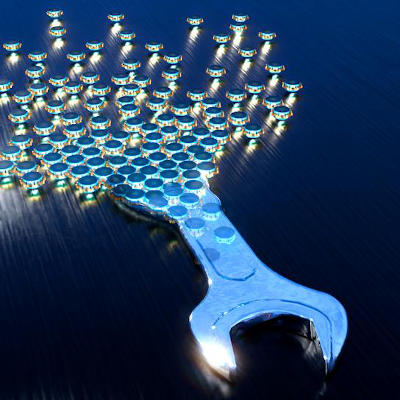

Researchers from UC Santa Barbara and TU Dresden have developed a group of robots that work together like a material. These robots look like small, disk-shaped hockey pucks. They can connect and form different shapes with unique traits.
A paper published in Science describes the methods and results of this study. There are also two press releases, issued by UC Santa Barbara and TU Dresden.
The researchers wanted to make a robotic material that stays stiff and strong but can also flow into new shapes when needed. They developed robots that use internal signals to change form, holding a shape or flowing into a new one.
Blurring robotics and biology
The researchers found ideas in biology, studying how embryos form. Living tissues in embryos are smart materials. They shape themselves, heal, and control their strength. Embryos can melt like glass to form shapes. Cells in embryos switch between solid and fluid states. This helps cells create forms like hands or bones. The researchers copied three key processes from embryos. First, cells push each other to move. Second, they use signals to coordinate. Third, they stick together for stiffness.
In the robots, gears on their edges act like cell forces, letting them push and move around each other. Light sensors mimic cell signals. These sensors use polarized light to tell robots which way to spin their gears and change shape. Shining light makes all robots align and move together. Magnets on the robots’ edges act like cell adhesion, pulling them together for strength. The team found that changes in light or force help the robots flow or stay stiff. In embryos, force changes turn solid tissues fluid. In robots, more fluctuations mean a flowing material, while stopping them makes it rigid again.
This discovery saves power. The robots use less energy with fluctuating signals than with constant force. This is unexpected but useful for robots with limited power. This work blurs robotics and materials, inspired by life itself.