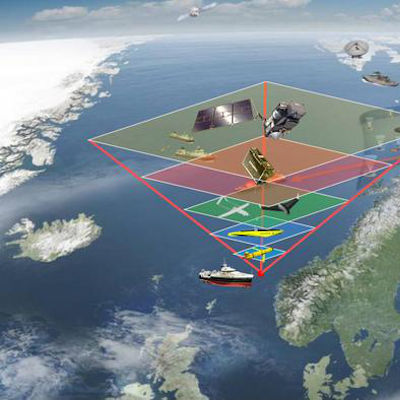

Scientists at Norwegian University of Science and Technology (NTNU), Equinor, and other partners have developed autonomous robotic organizations, or AROs, to perform complex tasks. AROs are groups of robots that organize themselves to complete missions. These robots communicate through a network. Human operators set the tasks, but robots adapt plans as needed. This flexibility allows AROs to handle jobs like ocean mapping or equipment repair, surpassing what single robots can do.
The researchers tested AROs in Svalbard using an observation pyramid, a setup combining different robots. They used autonomous underwater robots, or AUVs, which explore underwater without human control. Uncrewed surface vehicles, or USVs, operate on water surfaces. Uncrewed aerial vehicles, or UAVs, are drones that fly. Small satellites, orbiting devices, collect data from space. Together, these robots mapped algae blooms in Kongsfjorden, a fjord in Svalbard, using tools like SilCam, a camera for tiny water details.
Advancing robotic collaboration
AROs shift from single robots or simple groups to a system of systems, a network of coordinated platforms. This approach combines robots with different skills, like sensing or imaging, for faster, cheaper missions. Robots in AROs share tasks, making them stronger as a group. This teamwork cuts costs and boosts mission quality. The Svalbard tests showed robots working across sea, air, and space, collecting data together.
The research builds on 20 years of work in places like the Arctic and Atlantic. Partners like SINTEF and UiT helped develop advanced control systems, which guide robot actions. AROs use sophisticated cooperation skills, ensuring they stay robust, or reliable, even in tough conditions. Equinor already uses similar robots to monitor ocean ecosystems and check offshore structures.
This work, published in Science Robotics, aims to scale AROs for broader uses, like security or environmental monitoring. The researchers push boundaries with an interdisciplinary approach, combining engineering and marine science. AROs promise efficient, high-quality operations, revolutionizing tasks in oceans and beyond, while supporting safer, more sustainable technologies.