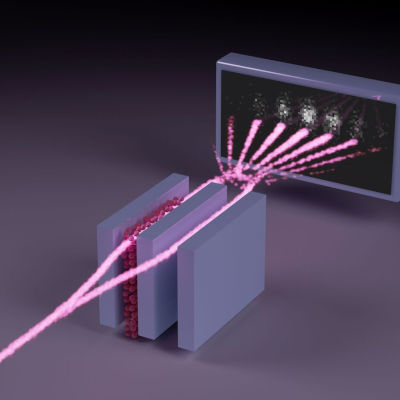

Researchers from the Universities of Göttingen and Hamburg, together with partners, have created the world's smallest X-ray interferometer. An interferometer is a highly precise instrument that uses the interference of waves to make exact measurements. The new device has two slits only 50 nanometres apart. This tiny scale allowed the group to measure the refraction of X-rays confined to a few nanometres and to understand how these rays interact with atomic nuclei.
The device builds on the famous double-slit experiment, a cornerstone of quantum mechanics. Experiments took place at the European Synchrotron Radiation Facility in France. The researchers placed atoms of the iron isotope 57Fe in one slit. They worked mainly with single X-ray photons. Each photon passes through both slits at once. When it interacts with the iron atoms in one slit, it creates distinct interference patterns that reveal the degree of refraction.
Insights into X-ray behaviour and future applications
From the strength of the refraction, the scientists drew conclusions about the interaction between X-ray photons and iron atoms. Building such devices is difficult because X-ray waves are extremely short, about a thousand times shorter than visible light, and their refraction is very slight. Yet this information is valuable. It supports X-ray phase-contrast imaging, a technique that produces detailed three-dimensional pictures of biological samples without causing damage. It also reveals how atoms are arranged inside matter.
The experiment demonstrates that light refraction provides data beyond simple light absorption, especially near atomic resonances. It lays groundwork for systematically measuring the refractive index of different elements for X-rays. The refractive index indicates how strongly a material bends light. In the future, this work may lead to integrated optical circuits for X-rays, enabling new tools in science and technology.
The researchers have described the methods and results of this study in a paper published in Nature Photonics.