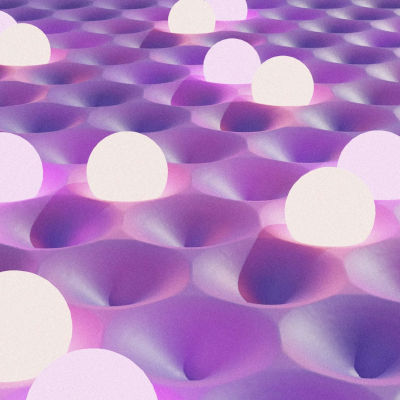

Researchers have directly imaged the quantum process behind superconductivity. Superconductivity is a phenomenon in which paired electrons allow electric current to flow without any resistance when materials are cooled to very low temperatures. The new observations, published in Physical Review Letters, used a gas cooled nearly to absolute zero. Absolute zero is the lowest possible temperature, where atomic motion almost stops. The gas - a Fermi gas - lets scientists study electron behavior by substituting atoms that follow similar rules.
The results surprised the scientists. After atoms paired up, their positions became linked to those of other pairs. The pairs kept a certain distance from one another, much like dancers avoiding collisions on a crowded floor. This coordinated movement was not predicted by the 70-year-old BCS theory, named after physicists Bardeen, Cooper, and Schrieffer. The BCS theory explains how electrons form pairs but treats the pairs as independent, without interactions between them.
New insight into pair interactions
The experiment used lithium atoms cooled to a few billionths of a degree above absolute zero. At these temperatures, the atoms behave as fermions, a class of particles that includes electrons and follow specific quantum rules. A new imaging method captured the relative positions of the pairs. Theoretical simulations based on quantum mechanics matched the observations and showed the missing details from the older theory.
These findings deepen basic understanding of superconductivity and related quantum materials. The work could help develop better tools to study more complex systems. Scientists hope such advances will one day lead to superconductors that work at everyday temperatures. Room-temperature superconductors would allow ultra-efficient power grids and electronic devices by eliminating energy losses from resistance. Current high-temperature superconductors still require cooling to around minus 196 degrees Celsius. The new detail about how pairs interact brings researchers closer to explaining and improving these materials.