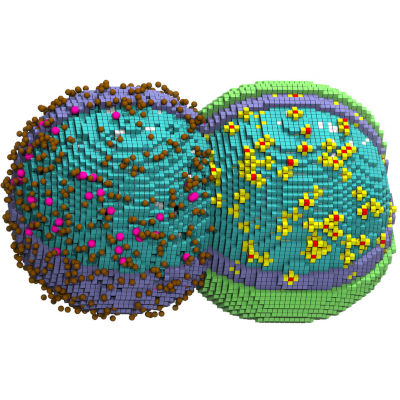

Scientists have created a detailed computer simulation of a minimal bacterial cell, tracking its entire life cycle from copying its DNA to dividing into two cells. A minimal cell is a simplified bacterium with only the genes needed for basic life functions like growing and reproducing. They used a type called JCVI-syn3A, which has fewer than 500 genes on a single loop of DNA. This simulation shows how every molecule in the cell behaves over time, using nanoscale resolution, which means viewing things at a billionth of a meter scale.
The work, led by the University of Illinois Urbana-Champaign, combined years of effort, powerful computers, and real lab data. They modeled genes, proteins (molecules that do most cell work), RNA (molecules that help make proteins), and chemical reactions. For accuracy, the model matched real cell events, such as the cell doubling in size before splitting. Experimental data from other labs helped confirm details like how DNA copies itself and how the cell divides evenly.
Overcoming simulation challenges
Simulating a crowded cell was tough because molecules constantly move and interact in three dimensions. DNA replication, the process of copying genetic material, slowed the computers, so researchers used separate graphics processing units to speed it up. This let them finish a 105-minute cell cycle in six days of computing. The model ignored some atomic details but averaged molecule behaviors, matching real timings within two minutes on average.
This dynamic model mimics a real cell's kinetics, or movement and reactions. It lets scientists study multiple processes at once, like metabolism (energy and growth reactions) alongside ribosome building (cell parts that make proteins). The approach opens new ways to explore life's foundations and could predict cell behaviors in experiments. Supported by national funding, it involved collaborators from various institutions and used advanced supercomputing resources.
The scientists have described the methods and results of this study in a paper published in Cell.