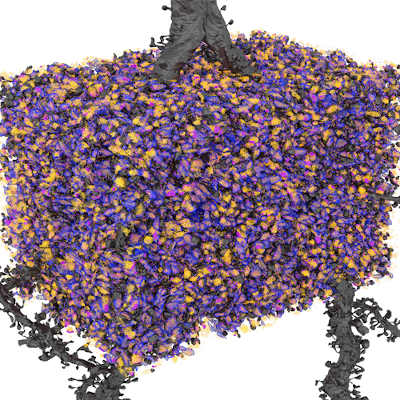

Scientists at Scripps Research have explored how the brain stores long-term memory. They have used advanced tools like genetic methods, 3D electron microscopy, and artificial intelligence (AI). Their study shows how memory traces, called engrams, form in the brain. An engram is a physical change in the brain that holds a memory.
The researchers focused on the hippocampus. This brain area helps with learning and memory in animals and people. They studied mice and marked neurons that turned on during a learning task. Using high-resolution imaging, they mapped the connections between these neurons. These connections, called synapses, are where neurons talk to each other. The AI sped up the analysis of these detailed images.
The findings surprised the researchers. Older studies thought learning added more synapses. Instead, the researchers found the number of synapses stayed the same after learning. However, neurons tied to the engram changed how they connected. They used multi-synaptic boutons, or MSBs. These are special spots on axons that send signals to many dendrites at once. Axons carry signals away from neurons, and dendrites receive them. MSBs grew more common and complex in these neurons.
New discoveries in brain wiring
There is yet another surprise. Experts thought engram neurons in nearby hippocampus areas linked up more. The researchers found they didn’t. Instead, MSBs helped these neurons connect to others not active during learning. The engram neurons also showed tiny changes in their synapses. These changes involved organelles like mitochondria, which power cells, and smooth endoplasmic reticulum, which helps make proteins. Astrocytes, cells that support synapses, also interacted more with these neurons.
The researchers want to see if these findings apply to other brain areas. They also wonder if problems with MSBs cause memory loss. They hope to target MSBs with drugs to treat memory issues. This needs new tools to study MSB molecules. The researchers are improving their AI to handle big imaging data better.
The researchers have described the methods and results of this study in a paper published in Science.