
Scientists have found a way to see how nanoparticles move and change. Nanoparticles matter a lot for making medicines, electronics, and energy materials.
“Nanoparticle-based catalytic systems have a tremendous impact on society,” explains Carlos Fernandez-Granda in a New York University press release. “It is estimated that 90 percent of all manufactured products involve catalytic processes somewhere in their production chain. We have developed an artificial-intelligence method that opens a new window for the exploration of atomic-level structural dynamics in materials.”
The scientists have described the methods and results if this study in a paper published in Science. They mixed artificial intelligence (AI) with electron microscopy.
Electron microscopy takes sharp pictures, but nanoparticles change fast during reactions, and this blurs electron microscopy images. The scientists trained a deep neural network to fix blurry microscope images.
Seeing the hidden dance of atoms
“Electron microscopy can capture images at a high spatial resolution, but because of the velocity at which the atomic structure of nanoparticles changes during chemical reactions, we need to gather data at a very high speed to understand their functionality,” adds Peter A. Crozier. “This results in extremely noisy measurements. We have developed an artificial-intelligence method that learns how to remove this noise - automatically - enabling the visualization of key atomic-level dynamics.”
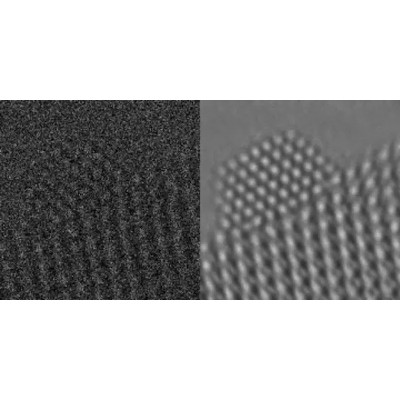
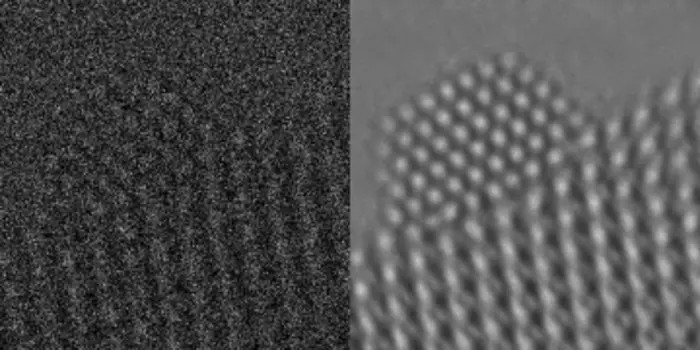
At first, pictures of a platinum nanoparticle showed atoms faintly through noise. After AI cleaned it up, the atomic structure popped out clear.
Watching atoms move helps understand how nanoparticles work in real jobs, like in factories. The scientists used topological data analysis (a way to study shapes) to track these shifts and see when particles settle or get messy.
This method lights up the hidden dance of atoms, making it easier to improve nanoparticles for practical use.