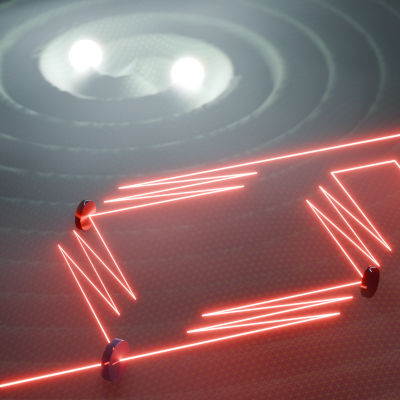

Gravity is a force that pulls things together, but it also creates ripples in the fabric of the universe. These ripples are called gravitational waves. They happen when very heavy objects, like black holes, crash into each other. These waves travel across the universe at the speed of light, causing tiny stretches in space-time. Physicists at the Helmholtz-Zentrum Dresden-Rossendorf (HZDR) have suggested that we can move energy back and forth between light and gravity.
This could be done using lasers. When the laser light hits a gravitational wave, a tiny amount of energy can jump from one to the other. This energy travels in tiny units called gravitons. A graviton is a theoretical particle that scientists believe carries the force of gravity, though no one has proven they exist yet. When light gives energy to a gravity wave, the light changes its frequency. This change is very small, but it can be measured.
Testing the quantum nature of gravity
To see these tiny changes, the experiment would need to be very large. The light would have to bounce back and forth between mirrors a million times. Even if the mirrors are only one kilometer apart, the light would travel a total distance of one million kilometers. To measure the result, scientists would use an interferometer. This is a tool that splits a light beam in two and then brings the beams back together to see if they still match. If the beams do not line up perfectly when they return, it creates an interference pattern. This pattern tells scientists if the light changed its energy level during the trip.
This experiment is important because it could prove the quantum nature of gravity. This is the idea that gravity is not just a smooth force but is made of tiny, individual building blocks. If the light changes in the way the scientist predicts, it would show that gravity and light are swapping gravitons. This would be very strong evidence that gravitons are real. If the light does not change, it would mean our current theories about gravity are wrong. This discovery would help us understand the basic rules that govern our entire universe.
This research is published in Physical Review Letters. Science communicator Sabine Hossenfelder has explained this research in a commentary.