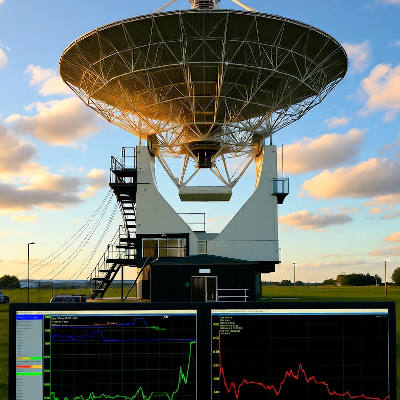

The SETI Institute has announced plans to use the new Nvidia IGX Thor platform to improve its search for signals from space. This happens at the Allen Telescope Array, or ATA, which is a group of 42 antennas in Northern California that scan the sky for radio signals. Radio signals might come from cosmic events, like bursts from stars, or possibly from intelligent life elsewhere in the universe. The IGX Thor is a powerful computer system designed for tough real-world tasks. It uses artificial intelligence (AI). This setup lets researchers process and understand the signals right at the telescope site, cutting down the time needed to spot interesting data.
A SETI institute press release explains that the IGX Thor runs AI tasks and fast signal processing close to where the data is collected. Its small size and low power use make it perfect for the next version of their system.
Building on past successes
This step forward comes after earlier work with Nvidia's IGX Orin, which helped create the first real-time AI search for fast radio bursts (quick flashes of radio energy lasting just milliseconds). The shift to IGX Thor will let researchers cover more sky area quickly and with better accuracy.
The press release notes that blending science with advanced tech changes how the universe is explored. The platform provides steady performance for complex AI models at the telescope.
The IGX Thor is also used in other areas, like factory safety and medical tools, showing its wide usefulness. The SETI Institute, started in 1984, is a non-profit group focused on studying life's origins and spread in the universe. It shares knowledge through research in physical and biological sciences, using data analysis, machine learning, and signal detection. The institute partners with industry, schools, and groups like NASA and the National Science Foundation.