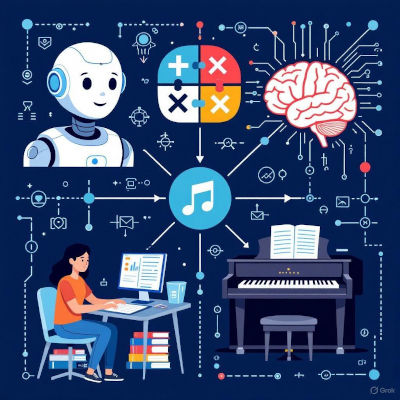

Researchers at Brown University have shown that humans and artificial intelligence (AI) combine two main ways of learning in similar patterns. This gives fresh ideas about how people learn and how to make AI more natural and reliable. The study is published in PNAS.
Humans learn in two key modes depending on the task. In-context learning is a fast method where people grasp rules after just a few examples, like figuring out tic-tac-toe quickly. Incremental learning is a slower process that builds skills over time through repeated practice.
Both humans and ai use these modes, but how they blend isn't firmly known. The researchers suggested this blending might resemble how human working memory, which holds short-term information like a phone number, interacts with long-term memory, which stores knowledge for years, like childhood events.
Testing AI to understand human patterns
In experiments, the AI first handled many similar tasks incrementally, which helped it develop fast in-context skills. For example, after training on 12,000 tasks involving lists of colors and animals, the AI could identify new combinations it had never seen, like a green giraffe. This shows that quick, flexible learning in AI emerges only after enough slow, building-block learning occurs, much like how people pick up new board games faster after playing many others.
The study also found trade-offs: AI systems, like humans, remember tasks better when they make errors, because mistakes trigger updates to long-term storage. In contrast, error-free quick learning boosts flexibility but does not stick as well in memory. These findings link different human learning styles that scientists had not connected before.
The work also suggests how to guide AI development, especially for sensitive areas like mental health, by highlighting where human and AI thinking align or differ. This could be a starting point for creating AI assistants that understand human cognition better.