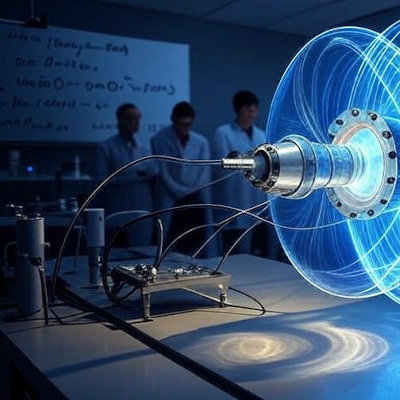

Partial differential equations (PDEs) are key to understanding complex systems like fluid flow or magnetic fields. Solving these equations is slow and costly with current computer methods. Researchers at the University of Utah have developed a device called the optical neural engine, or ONE. This device uses light to process PDEs, making calculations quicker and less energy-intensive than traditional methods.
The ONE combines special optical components, like diffractive optical neural networks (systems that mimic brain-like processing using light) and optical matrix multipliers (tools that perform math operations with light). Instead of using digital data, the ONE represents PDE variables, such as pressure or flow, with light properties like intensity (brightness) or phase (wave position). As light passes through the ONE’s components, these properties shift to form the solution to the PDE. This optical method is faster than electronic machine learning, which processes data through computational nodes (units that weigh and pass information) to find solutions.
A leap in computational efficiency
The researchers tested the ONE on several PDEs, including the Darcy flow equation (describing fluid movement through materials like soil), the magnetostatic Poisson’s equation (related to magnetic fields), and the Navier-Stokes equation (modeling fluid motion). For example, the ONE can take data about a material’s permeability (how easily fluid passes through) and pressure, then predict flow patterns without physical experiments. This ability is valuable for fields like geology or chip design, where simulations save time and money.
Compared to electronic methods, the ONE uses less energy and works faster, offering a powerful tool for large-scale scientific and engineering tasks. The research, published in Nature Communications, was supported by the National Science Foundation, the University of Utah, and the U.S. Department of Energy. By using light to solve complex equations, this innovation could transform how scientists and engineers tackle challenging problems, making computations more efficient and accessible for future discoveries.