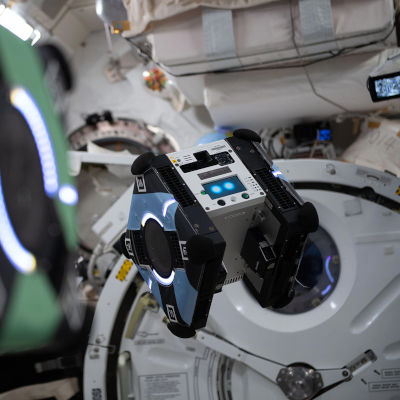

Stanford researchers have shown for the first time that artificial intelligence (AI) can control a robot on the International Space Station. The robot, called Astrobee, is a cube-shaped device about the size of a toaster that floats using fans. It helps with tasks like moving supplies or checking for leaks, freeing astronauts for other work. The space station is a tight, complex place full of equipment, making safe movement hard. Traditional planning methods are slow because the robot's computer has limited power and must ensure no crashes.
The researchers used a method called sequential convex programming, which breaks big problems into smaller steps to find safe paths. To speed it up, they added machine learning, a type of AI that spots patterns from examples. They trained the AI on thousands of past paths, giving the robot a "warm start," or a good initial guess, before fine-tuning.
Testing AI in orbit
Before space tests, the researchers tried the robot on a ground setup at NASA that mimics low gravity. On the station, astronauts set up the robot but let it run alone. The researchers sent commands from Earth, testing paths with and without the AI help. Results showed the AI made planning 50 to 60 percent faster, especially in cluttered or narrow areas. Safety stayed the same, with virtual obstacles to avoid real risks.
This marks a key step for space robotics. As missions go farther, like to the Moon or Mars, robots will need to work more on their own. The technology reached a NASA readiness level showing it works in real conditions. Future work will use stronger AI models for even tougher tasks, helping astronauts focus on important jobs while robots handle routine ones efficiently.
The concept and technical implementation of this AI system had been described in a preprint published in arXiv.