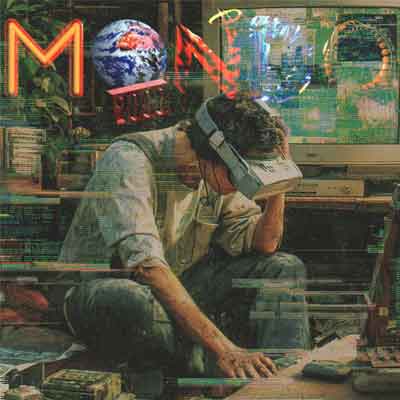

You would think that as the cutting edge, New Edge, cyberzine of the 90s Mondo 2000 would have been shouting (in text and images) about the internet. Well, we did drop content about the pre-web internet, but the thing we were really after in the early 90s was Virtual Reality. It was, of course, way premature. (As far as I’m concerned, it’s still rather premature).
It was around 1988 that Jaron Lanier started coming around to what would soon be known as the Mondo House to see Debbie Harlow, an attractive young psychedelic researcher who rented a room there. He explained his work with VPL, developing VR goggles and gloves for entering and navigating 3d spaces. We were hearing so much far-out stuff at that time that we sort of filed it away. Yes, this was one of the more interesting (and believable) technological in-progress aspirations we’d heard, but we would not have predicted its perhaps overly enthusiastic embrace by psychedelic figures like Timothy Leary and Terence McKenna or that it would become the Next Big Thing in tech reportage in the early 90s, with dozens of conferences filled with academics, technologists and freelance weirdoes scratching their heads about the meaning of it all.
Leary and Lanier had a brief bromance as each told us that the other was the smartest person around. Leary even suggested that Jaron’s mind should be bottled and sold over the counter to help smarten up the dullards in the Reaganoid Nation. This intellectual mutuality would fray on both ends as Leary inevitably hyped VR as electronic LSD and Jaron just said no. Still their friendship survived the disagreement over the acidity of the tech.
VR enthusiasts didn’t want to stare at screens to interact with others over the net. They wanted to meet each other in realistic or surrealistic environments—to play, share visions and even have erotic encounters with others inside simulated worlds.
For Lanier, interactions via non-VR medias, information technology medias that failed to put us into a fully-saturating 3d environment, would be alienated and alienating, information, not life. As he told John Perry Barlow in an interview in Mondo #2, “Information is alienated experience.” Lanier wanted us to move into the digital age virtually embodied, as presences inside worlds. He told us that the illusion of physicality would make for a kinder and gentler internet.
Lanier said: “The first problem is that it’s information. The second problem is that it’s linear information… The computer is a map that you can inhabit. Which is very seductive. It’s mostly seductive because you love what you have to struggle for, but it’s also seductive because it makes you seem very powerful in comparison to it. So it’s good for the ego. Virtual Reality is a new landscape, not a new map. That’s what makes it a completely different thing from computers.”
VR was the theme of the second Mondo issue. Among other pieces, we had features from Autodesk’s main VR experimenters. Autodesk,the architecture oriented software company that was briefly taken over by thefreaks under the management of the hacker genius John Walker, provided content hyping their intentions. Timothy Leary’s friend and writing compadre Eric Gullichsen was among those heading up the attempt. Nothing, to my knowledge, came of this attempt, although Gullichsen formed a private company called Sense8 (the Wachowski’s sure appropriated that title!) with Pat Gelband that made a reasonably impressive rudimentary VR system. And Howard Rheingold, to his lifelong regret, was coaxed into writing about ‘teledildonics’, i.e. virtual sex.
Mark Pesce was one of the people influenced by the Barlow-Lanier conversation. Lanier opined that VR wasn’t the new television… “it’s the new telephone.” Pesce started working on his Virtual Reality Markup Language (VRML) as a consequence of reading the interview.
So. Is it the new telephone? Is it mainly used for entertainment or for interactions between persons (actual persons, not bots)? A brief exploration suggests that the answer is ambiguous. According to our friendly Google AI, Gemini, VR seems to be mainly used in entertainment, some of which is interactive and some of which is not. Within the context of entertainment, it’s largely used in gaming and often emphasizes users interfacing as individuals in prefabricated game worlds. Some involve others and some don’t.
VR idealists imagined people escaping the rut of entertainment programming (TV) and becoming engaged in the imaginative play of building worlds in collaboration with others. But really, after a day of underpaid slave labor driving Uber or peeing in bottles while delivering for Amazon, who wants to return home to the wretched hovel and go online to “have fun” building worlds? Give me a joint, a beer and an episode of The Boys. (Isn’t Homelander starting to seem comparatively benign?) Maybe if we Steal This Singularity and institute a postcapitalist playful world, people will want to build virtual realities. I mean, on the off chance that some future beings will find themselves living their lives—experiencing the VR worlds we start to build in the near future as the actual world, it should perhaps be more amusing and visually enthralling than the one we are currently occupying, as rich as it is. Or maybe it should just be kinder… post-Darwinian. The history of gaming, in this context, does not bode well. Indeed, since the Steal This Singularity team has suggested STS as a revolting game (a game of rebellion), are we perhaps leading things off in the wrong direction? Whatever. We’ll see you in hell, future people!