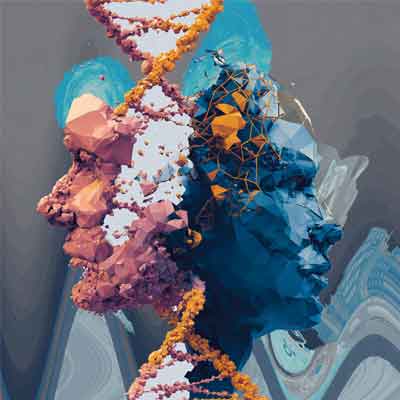

Why the future of learning isn't a solo genius, but a well-managed team. Training an AI agent is an exercise in stubbornness. You set a goal—like teaching a robotic hand to spin a cube—and watch as it tries the same clumsy grab, over and over, a million times in a simulation. The problem isn't a lack of compute; it's a lack of ideas. For decades, the field has been split between two flawed philosophies: the efficient but narrow "student" (policy gradients) and the wildly creative but wasteful "explorer" (evolution). Jianren Wang, Yifan Su, and the team at Carnegie Mellon's Robotics Institute saw this not as an either-or problem, but a management challenge. Their solution, Evolutionary Policy Optimization (EPO), doesn't build a better learner. It builds a better team. By merging evolution with deep learning, EPO creates agents that are both brilliantly adaptable and ruthlessly efficient, cracking complex robotics tasks that leave other AIs stuck at zero.
The Stalemate: Genius vs. Chaos
Reinforcement learning has two tribes. On one side are policy gradient methods like PPO—the disciplined scholars. They learn efficiently from their own actions but are famously myopic, easily getting trapped in local optima. Give them more computing power, and they just do more of the same slightly differently, failing faster. On the other side are evolutionary algorithms—the chaotic explorers. A population of agents tries random strategies, ensuring boundless creativity but at a glacial pace. It's the difference between a prodigy practicing one sonata perfectly and a thousand monkeys banging on typewriters. The trade-off has been considered fundamental: you could have speed or breadth, but not both. This stalemate has been the primary bottleneck for training generalist robots that need to adapt in the real world.
The EPO Engine: A Two-Phase Machine
The researchers' breakthrough was architectural. They stopped trying to improve the soloist and instead designed a symphony. "The core idea," they state, "is to integrate the population-based exploration of Genetic Algorithms with the powerful policy gradient." EPO works in two interconnected phases: a crowd that explores, and a master that learns.
Phase 1: Building the Exploratory Crowd
EPO starts not with one agent, but with a portfolio. It initializes a population of agents, each with a unique "latent gene"—a small piece of code that acts like a personality seed. The genius is that all agents share the same core brain (the actor-critic network). This is like giving 100 unique pilots the same, highly advanced cockpit. One personality might be cautious, another reckless, a third obsessive. When unleashed on a problem—like getting a robot dog to traverse rubble—this crowd generates a massive, diverse logbook of attempts. It's not random search; it's an intelligent, structured variety.
Phase 2: The Synthesizing Master
This is where EPO transcends a simple committee. One agent is designated the Master. Its full-time job is aggregated learning. In every training cycle, it doesn't just review its own experience. It uses importance sampling to safely learn from the collective successes and failures of the entire population. The Master is the team's lead analyst, spotting patterns in the crowd's chaos that no individual explorer could ever see.
The Darwinian Manager: Curating the Crowd
A silent, automated manager runs in the background. Periodically, it applies Darwinian selection: low-performing personalities are culled. The "elite" genes of top performers are combined (crossover) and slightly altered (mutation) to create the next generation of explorers. This ensures the crowd doesn't just generate data—it generates increasingly useful data. The system creates its own virtuous cycle: better exploration data leads to a smarter Master, whose improved policy guides the crowd toward more fruitful exploration.
Results: Where Other AIs Hit Zero
The team tested EPO on a brutal gauntlet: dexterous manipulation with multi-fingered hands, legged robot parkour, and humanoid control. The results reveal not an improvement, but a new tier of capability.
On tasks where state-of-the-art baselines like PPO and SAC flatline—such as complex two-arm robotic coordination—EPO achieved success rates of over 37%, where others scored near zero. It didn't just learn faster; it learned things other algorithms couldn't grasp at all. Furthermore, while traditional methods see diminishing returns with more computational power, EPO's performance scales linearly. More agents mean more diverse data, which makes the Master agent smarter. The scaling bottleneck is broken.
What’s Still Missing? The Road from Lab to World
EPO is a masterclass in algorithmic engineering, but its current victory is in simulation. The bridge to physical robots—with all their noise, wear, and unforgiving physics—remains to be crossed. Furthermore, the "personality" genes, while effective, are black boxes. Making them interpretable could unlock even more directable and trustworthy agents. Finally, the paradigm raises a fascinating question: if this team-based approach works so well for robot motor skills, could a similar "portfolio of thinkers" accelerate the development of reasoning and alignment in large language models?
The Bottom Line
The quest for general AI has long been a search for a better algorithm. Evolutionary Policy Optimization suggests the next leap might come from a better organizational principle. It proves that intelligence doesn't have to be a trade-off between focus and curiosity. By architecting a system where a diverse crowd explores and a singular intellect synthesizes, Wang, Su, and colleagues haven't just built a better RL model. They've built a blueprint for a new kind of learning machine—one that is, finally, both wise and adventurous.
References
Wang, Jianren, et al. "Evolutionary Policy Optimization." arXiv.org, March 28, 2025. https://arxiv.org/pdf/2503.19037