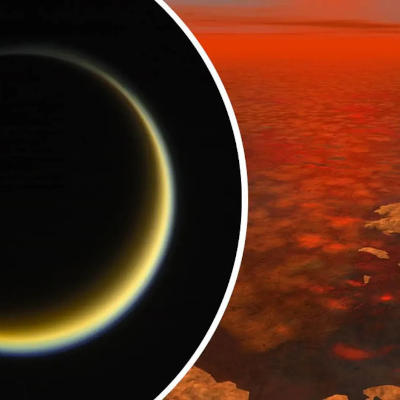

Researchers from Chalmers University of Sweden and NASA found that on Saturn's moon Titan, substances that normally do not mix can combine in its freezing cold environment. This discovery challenges a basic chemistry rule and gives new clues about how life might have started. Titan is Saturn's largest moon. It has an orange haze and a thick atmosphere of nitrogen and methane. These conditions look like early Earth billions of years ago, before life began.
The study, published in PNAS, shows that hydrogen cyanide mixes with methane and ethane to form stable co-crystals. Hydrogen cyanide is a polar molecule. Polar means it has a positive side and a negative side, like a tiny magnet. Methane and ethane are nonpolar. Nonpolar means they have no charge difference, like oil. Normally, polar and nonpolar substances stay apart, like oil and water. But at Titan's low temperature of about -180 degrees Celsius, they blend inside crystal structures.
New insights into the building blocks of life in extreme environments
Laser spectroscopy helped spot this mixing. Laser spectroscopy is a method that uses light to study molecules closely. Computer simulations then confirmed it by testing thousands of molecule arrangements. The co-crystals match NASA's lab tests on Earth.
This finding changes how we see Titan's landscape of lakes, seas, and dunes made of methane and ethane. Hydrogen cyanide helps form life's building blocks, like amino acids for proteins and nucleobases for DNA. Amino acids are the parts that make proteins, which build body tissues. Nucleobases are the letters in genetic code. The discovery shows prebiotic chemistry, or chemistry before life, can happen in harsh cold places.
It does not break chemistry rules everywhere, but shows they bend in extreme cold. Hydrogen cyanide exists in space dust, planet atmospheres, and comets. This work aids studies of other cold worlds.
NASA's Dragonfly probe will reach Titan in 2034 to check prebiotic chemistry and signs of life. Under Titan's icy surface, a water ocean might hold life. Until then, researchers will study more hydrogen cyanide mixes.