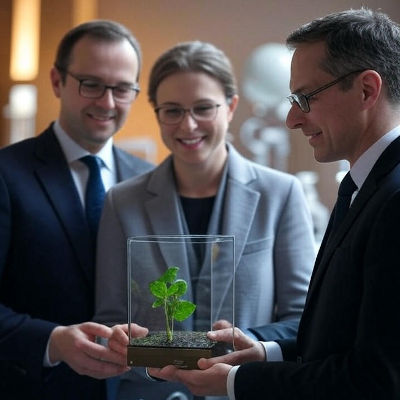

The NOMIS Foundation, a private Swiss organization, is giving €20 million to support bold research at the Institute of Science and Technology Austria (ISTA) in Klosterneuburg.
This partnership, starting in 2026, will fund projects for five years that explore new ideas with the potential to greatly expand our knowledge. Interdisciplinary projects (research combining different fields) will be chosen each year, lasting up to four years, with details shared in the fall. The total funding of 20 million euros will be spread from 2026 to 2030, providing 4 million euros annually.
Focus on Courageous Discovery
ISTA, founded in 2009 near Vienna, hosts about 90 research groups studying basic questions in natural sciences, mathematics, and computer science. The NOMIS Foundation aims to support groundbreaking, insight-driven science across all disciplines, focusing on researchers who put forth bold new ideas, exhibit a pioneering spirit and seek to inspire the world around them. This requires courage to tackle high-risk ideas with big rewards. Leaders at both organizations are excited about this collaboration, hoping to push the boundaries of science and inspire new discoveries that could change the world for the better.
'With this joint program, we want to promote ideas that no one has dared to explore before - because the risk of failure is high, but the potential gains are just as groundbreaking,' says ISTA President Martin Hetzer. “Our vision is to ‘ignite sparks’ in the world of science," adds Markus Reinhard, Managing Director of the NOMIS Foundation.
In related news, the NOMIS Foundation has named Wolfgang Busch, Markus Rex, and Sara Seager as 2025 Distinguished Scientist and Scholar Award recipients for their innovative research. Busch at the Salk Institute explores plant root adaptability, mapping their chemical perception. Rex at the Alfred Wegener Institute studies Arctic climate feedback using machine learning. Seager at MIT advances exoplanet research, investigating life in extreme environments like Venus.