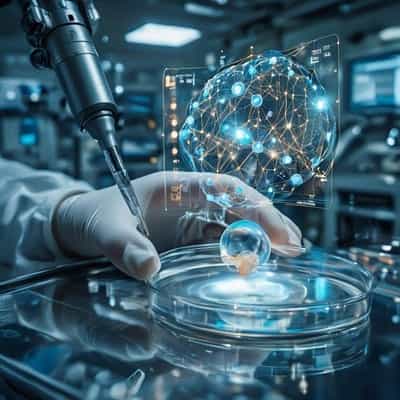

A new era of artificial intelligence is transforming in vitro fertilization, bringing unprecedented precision to every step from sperm selection to embryo transfer while raising important questions about oversight and ethics. [1]
The integration is happening rapidly. Surveys show AI usage among fertility specialists grew significantly, with over half reporting some use by 2025. The technology addresses critical bottlenecks: systems like Columbia University's STAR (Sperm Tracking and Recovery) can find viable sperm in samples where experienced embryologists found none, leading to pregnancies after many failed cycles. For embryo selection, AI tools analyze thousands of subtle patterns in time-lapse images, outperforming human embryologists in predicting viability. One review found AI models achieved 81.5% accuracy for predicting pregnancy, compared to 51% for embryologists. AI is also moving into full automation, with the first baby born in 2024 from a system that robotically performs fertilization. [2]
Beyond the lab, AI personalizes treatment. A clinical trial of the Opt-IVF decision tool demonstrated that AI-guided hormone dosing could reduce medication needs by approximately 30% while increasing pregnancy rates. Furthermore, research indicates AI may help non-invasively predict an embryo's chromosomal status from images alone, with tools like the BELA system showing promise as an alternative to invasive genetic testing.
Despite the promise, experts urge caution in this largely unregulated field. Key concerns include the "black box" nature of some algorithms, where the reasoning behind a decision is unclear. There is also significant worry about premature commercial adoption before robust clinical trials prove that a tool genuinely improves live birth rates. The push for rigorous, prospective validation is now a central theme as the field evolves. [3]