
The World Before the Hill
Imagine you are teaching a robot to toss a ball into a basket. The robot keeps missing, sometimes wildly to the left, sometimes short. You could tell it to “try harder,” but without feedback, it has no idea how to improve.
This is the essence of many real-world problems: whether predicting house prices, recognizing handwriting, or generating images, machines must learn from mistakes. Each mistake adds to the “distance” the robot must travel to reach success a measurable number called loss. The bigger the loss, the farther the journey. Minimizing this distance is the core challenge, and this is where our journey begins: the slippery hill the blind traveler must descend.
Neural networks solve this by converting real-world tasks into mathematical problems. Each prediction the machine makes is compared against the truth, producing a loss a single number that measures how wrong it is. Minimizing this number is equivalent to solving the problem. And this is where the journey begins: the hill that the blind traveler must descend.
From Real Life to a Hill
Before a neural network can learn, we must translate the messy, analog world into something the network can measure. For example, if a model predicts house prices, each wrong prediction contributes to a loss function essentially a map of “how far off” the model is.
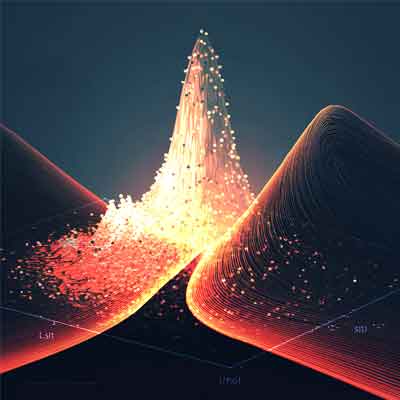
Now, imagine this loss function as a mountainous landscape: high peaks represent large errors (longer distance to success), valleys represent smaller errors (shorter distance), and the absolute lowest valley represents perfect predictions (zero distance). The network’s goal is simple in principle: reach the lowest point as efficiently as possible.
But there’s a catch: the traveler is blind. The machine cannot see the entire landscape; it can only sense the slope where it currently stands. Every step it takes is guided by the gradient the direction that decreases the loss the fastest. Technically, this is achieved by updating parameters θ in the opposite direction of the gradient ∇θJ(θ), scaled by a learning rate η: θ = θ − η · ∇θJ(θ).
The Blind Traveler
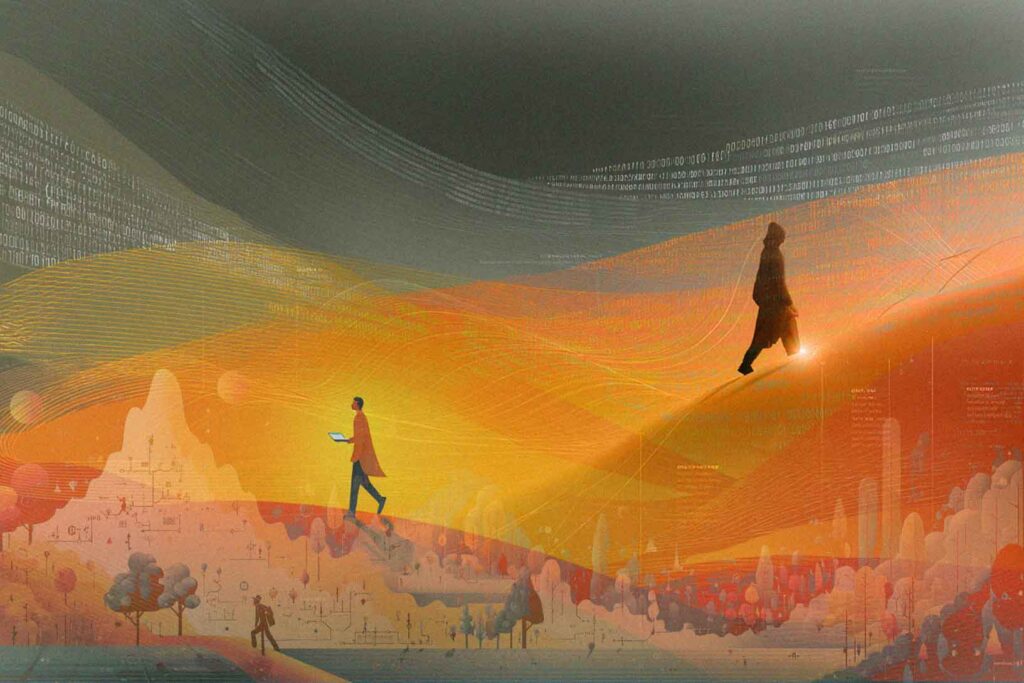
Our blind traveler now takes the first step. He feels the slope beneath his feet and moves a small distance downhill. This is gradient descent, the foundational algorithm behind neural network training.
- Step size = learning rate: too large, he might tumble past the valley; too small, he will crawl forever.
- Direction = negative gradient: always going “downhill,” even if he can’t see the entire mountain.
There are three main variants: Batch GD computes the gradient over the entire dataset (slow but precise); Stochastic GD (SGD) uses one example per update (fast but noisy); Mini-batch GD balances both, using small groups (e.g., 50-256 examples) for efficient, stable progress.
The Many Ways Down the Hill (Optimizers)
Over time, travelers learned smarter ways to descend the hill. Each new method introduced a clever trick some aimed for speed, others for safety, and some for efficiency. Let’s explore these journeys down the hill and see how each optimizer changes the traveler’s path.
a. Stochastic Gradient Descent (SGD)
Instead of checking the slope of the entire mountain at once (batch GD), SGD takes a random sample of the terrain for each step. Imagine hopping down the hill blindfolded, feeling only a small patch of ground at a time.
- Advantage: Each step is faster and cheaper because the traveler checks only a small patch of terrain at a time. It enables online learning and can escape local minima due to its noisy updates.
- Disadvantage: The path is noisy the traveler jumps around, sometimes veering off course, making the journey less smooth. Update rule: θ = θ − η · ∇θJ(θ; x(i); y(i)).
b. Momentum
Momentum gives the traveler inertia. Instead of slowing down at every small bump, the traveler rolls over shallow dips and keeps moving steadily.
- Analogy: Like a ball rolling down the hill, momentum helps it build speed, maintaining a smoother, faster descent. It adds a velocity term vt = γvt−1 + η∇θJ(θ), then θ = θ − vt (γ ≈ 0.9).
c. Nesterov Accelerated Gradient (NAG)
NAG adds a touch of foresight. Before taking a step, the traveler peeks ahead to see what the terrain looks like, adjusting their stride accordingly.
- Effect: Moves faster while avoiding overshooting valleys, navigating the hill more precisely. It computes the gradient at an anticipated position: vt = γvt−1 + η∇θJ(θ − γvt−1), then θ = θ − vt.
d. Adagrad
Adagrad adapts each step individually. Parameters that are slow to change get larger steps, while fast-moving ones take smaller steps.
- Advantage: Quickly learns in directions that need more attention by taking bigger steps where needed. Ideal for sparse data; accumulates squared gradients in the denominator for per-parameter learning rates.
- Limitation: Over time, step sizes can shrink too much, causing the traveler to move very slowly and sometimes stall before reaching the valley.
e. RMSProp
RMSProp fixes Adagrad’s main issue. By balancing past and present slopes, it keeps the traveler moving even after many steps.
- Effect: Learning continues smoothly without plateauing too soon. Uses a decaying average of squared gradients (exponential moving average) to prevent the denominator from growing indefinitely.
f. Adam
Adam combines the best of momentum and RMSProp.
- Momentum part: Remembers past steps, helping the traveler keep rolling (first moment estimate).
- RMSProp part: Adjusts step sizes based on recent slopes, adapting to the terrain (second moment estimate).
- Effect: Smooth, fast, and reliable descent the go-to optimizer for many deep learning problems. Includes bias correction for early iterations; update involves vt (momentum) and mt (adaptive rates).
g. AdamW and Beyond
AdamW refines Adam by handling weight decay correctly, improving generalization. Modern optimizers like Lion and NovoGrad continue this trend, offering even smarter strategies for descending complex hills.
- Effect: Small tweaks can make a big difference in learning speed and stability. The paper also discusses AdaMax (extending Adam to l∞ norm) and Nadam (NAG + Adam).
When the Hill Gets Weird (Challenges)
Even the smartest travelers encounter tricky terrain. Some hills have unexpected twists that make the journey more challenging:
- Local minima: Small valleys that aren’t the lowest point, where travelers might get stuck thinking they’ve reached the bottom.
- Plateaus: Flat regions where every step feels the same, slowing progress to a crawl.
- Saddle points: Deceptive passes that can mislead travelers, making it hard to know which way to go. These are surrounded by plateaus of near-zero gradients, especially in high dimensions.
Despite these obstacles, optimizers guide the blindfolded traveler toward the true global minimum, each using strategies that balance speed, stability, and adaptability. Learning rate schedules (e.g., annealing) and adaptive methods help mitigate issues like diverging or slow convergence.
Beyond the Hill
Gradient descent and its optimizers are the heart of neural network learning.
- Weights = traveler’s position.
- Loss = how long does it take you to get to the bottom.
- Optimizers = strategies to move efficiently.
These algorithms power tasks you interact with daily:
- Image recognition (face unlock, self-driving cars)
- Natural language understanding (chatbots, translation)
- Generative AI (art, music, text)
Even beyond AI, gradient-based optimization appears in economics, physics, and biology wherever systems try to find optimal solutions. For parallel setups, techniques like Hogwild! (lock-free updates), Downpour SGD (asynchronous), and EASGD (elastic linking) scale to clusters. Additional tricks include shuffling data, curriculum learning (progressive difficulty), batch normalization (re-normalizing activations), early stopping (halting on validation plateaus), and gradient noise (adding Gaussian variance for robustness).
The Journey Continues
From humble steps to confident strides, neural networks learn by feeling their way down the dark hill, blind but persistent. Each optimizer is a new trick, helping machines learn faster, smoother, and smarter.
Understanding gradient descent is not just about algorithms it’s about appreciating the art of learning itself. The blind traveler reminds us that progress is always possible, even when the path is uncertain.